
 In the desert basins and mountain ranges of the Southwest and northern Mexico, you will discover, on the surfaces of boulders and rock exposures, galaxies of enigmatic figures chiseled or scribed or painted by human hands hundreds to thousands of years ago. These images on stone, says preeminent authority Polly Schaafsma in Indian Rock Art of the Southwest, are “probably man’s most enduring art form.” They also rank high among man’s most beguiling and mysterious expressions of worldviews, belief systems and spirituality.
On stony surfaces across our arid land, you may find, for instance, strangely abstracted and haunting graphic expressions of a mind apparently untethered from reality, presumably the work of a hallucinating shaman reaching for the spirit world. You may find figures, awash in symbolism, of prehistoric deities, rituals, masks, dance, ceremonies and pilgrimages. You can see portrayals of warriors with shields, each covered with the symbols of the owner’s magic. You may find representational, stylized or even whimsical depictions of men, women and children; mammals, birds, fish, reptiles and insects; and agricultural plants, especially corn. You will often see images of human faces, eyes, handprints, footprints and animal and bird tracks. Always, you will find geometric designs – for instance, spirals, concentric circles, zigzags, parallel lines and step-fret shapes – visual odes to a long-forgotten purpose.
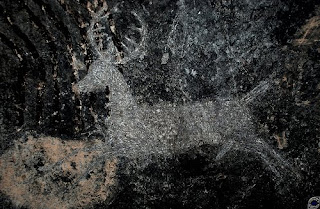
Frequently, as you may see, the artists produced their images – called “rock art” by archaeologists – at sites in distinctive geographic settings, for example, canyons, arroyos, streams, ridges, escarpments and mountain foothills, and typically, they chiseled, pecked, scraped, scored and painted on the walls and ceilings of alcoves and rock shelters, the faces of prominent rock exposures, and the surfaces of large boulders. (Images carved into the surface are called “petroglyphs,” those painted onto the surface are called “pictographs.”)

 Interpretations
Should you explore the rock art of our deserts, you may become ensnared in one of the great mysteries of Southwestern archaeology: What do the images signify? What do they mean? Puzzling over the images, you may soon recall Winston Churchill’s famous phrase “an enigma wrapped in a mystery” (which he used to describe the impenetrable Soviet Union).
Anthropologists, archaeologists, art historians and other scholars have a difficult time addressing the question. Oftentimes, they cannot look beyond an image to see the abstract notions and beliefs that inspired an artist to produce it. They have few tools for dating most rock art. Sometimes, they cannot correlate rock art with other archaeological records such as structures, fire hearths, potshards, stone tools and bones. Still, they have offered speculations about the meanings, sometimes generating considerable disagreement and controversy.
Anthropologist and investigator Kay Sutherland once suggested to me that prehistoric shamans, who most likely used hallucinogenic plants such as the Sacred Datura to induce an “otherworldly” state, may have produced rock art for use as portals through which they could enter the spirit world. Speaking to the importance of shamans in their book Tapamveni, Patricia McCreery and Ekkehart Malotki said, “The role of the shaman is to benefit and regulate the well-being of his people. He (or she) is capable of soul flight to the upper world or travel to nether realms to mediate with spirits and gods. The shaman combats evil, cures illness, promotes fertility, controls weather, and with the help of animal spirit helpers, ensures success of the hunt.” Shamans probably produced a high percentage of our rock art.

 Moreover, as F. A. Barnes said in his Canyon Country Prehistoric Rock Art, “…it is fairly certain that a lot of Anasazi [the Puebloan tradition of the Four Corners region] and Fremont [the Puebloan tradition of southern Utah] rock art was created for ceremonial purposes, whatever its figures depict. Other high probability meanings and uses are sympathetic magic (as depicted by innumerable hunting scenes), territorial claims (such as clan or dwelling area boundary markers), fertility symbols (coition, pregnancy and birth), special individuals (highly decorated or unusual anthropomorphs), supernatural beings (definitely non-real figures, probably for ceremonial use), weather control (clouds, lightning, whirlwinds and rain), record keeping (counting marks), astronomical events (depictions of supernova and solar calendars), cultural intrusions (macaws) and a variety of other minor uses.” Other authorities suggest that rock art figures may depict historic events, migrations, cultural relationships, trade expeditions, maps, traders and trade routes.
 In his controversial The Rocks Begin to Speak, La Van Martineau contends that artists produced images as a form of “rock writing.” In one example, he suggests that figures on a vertical rock wall at western Texas’ Hueco Tanks State Historic Site symbolize the story of an 1839 battle between Mexican militia from El Paso and Kiowa raiders from the Southern Plains. He points, for once instance, to an upside-down figure that represents, in his view, a dead Kiowa.

 “…of surpassing interest to most general readers,” said Schaafsma, “are the questions: What does it mean? Are these rock drawings a language awaiting interpretation? Interpreting rock art designs is intriguing yet difficult, often impossible.”
In their rock art, the prehistoric and early historic peoples of the Southwest left us with a compelling, if often bewildering, view into their religious and material lives.
Recurrent Symbols
You may find that some of the most fascinating images include those that recur frequently, sometimes in different forms, over a wide range through long time periods. These may hint at cultural contacts, development, affiliations and ranges. Among the most prominent are figures such as Kokopelli (possibly a god of well-being and fertility), Quetzalcoatal (a deity of agriculture, water and fire), Tlaloc (a deity of storms and rain), a Blacktail Rabbit (a symbol of the moon and fertility) and the Storyteller (presumably a keeper of tribal history and mythology).

 Kokopelli, often called the “humpbacked flute player,” appears in many forms, possibly spanning a wider area than any other single representational rock-art figure. At least one authority, Michael Claypool, who has taught short courses on Kokopelli (a Hopi word) at Fort Lewis College in Durango, Colorado, suggested the possibility that the figure had origins in Peru more than 1000 years ago. A widely experienced archaeologist friend has told me that Kokopelli-like figures turn up, not only across the Southwest and northern Mexico, but also in southern Mexico and Central America. Typically distinguished by an arched back and a clarinet-like flute, Kokopelli appears in Southwestern rock art in many forms, for instance, as a kilt- and sash-clad human, a humpbacked rabbit, a mountain sheep or a locust. A charismatic figure, he appears to take the role of an impregnator of women, a leader of a migration, the choreographer of ceremonial dance, or the guarantor of hunting and farming success. He may be portrayed as dancing, sitting, lying or walking. Historically rooted or mythical, Kokopelli apparently had a pivotal role in ancient rituals and the history of the prehistoric Southwest.
Quetzalcoatal, with origins in the great city-states of southern Mexico, or Mesoamerica, first appeared as a plumed serpent—a snake with a plume of feathers above its head. He gave humankind corn, domesticated animals, irrigation technology and fire. In some Puebloan societies, he commands underground water sources, and, if displeased, he can cause earthquakes and floods, according to Schaafsma. Borne northward into the greater Southwest, possibly by traders and religious proselytizers, Quetzalcoatal apparently evolved from a serpent with a feathered plume into a serpent with a feathered plume and a forward-pointing horn then into a serpent with only a forward-pointing horn and finally into a serpent with a backward-pointing horn. His progression may have been attributable to the influence of pre-Puebloan hunting cultures, which often used animal horns in their symbolism, suggested Sutherland in her “Spirits from the South,” The Artifact, El Paso Archaeological Society. He seems, according to a variety of sources, to be associated with a portfolio of other symbols, for instance, a bearded and helmeted man, a collared jaguar, the spiral, and an outlined cross or star symbol.
 Tlaloc, usually signified by goggle eyes, a snarling mouth and bared teeth, also originated in Mesoamerica. Conveyed northward into the Southwest, presumably by Mesoamerican traders and proselytizers, he seems to have ascended in importance in parallel with emergent Puebloan traditions. Closely associated with agriculture and rain, Tlaloc, like Quetzalcoatal, seems to have evolved in his Southwestern manifestations, possibly because of the influence of hunting cultures. From elaborate and stylized faces in Mesoamerica, Tlaloc morphed, for one example, into a figure with a trapezoidal head and trapezoidal body, said Sutherland. “The head has goggle eyes and an ornate head dress; the body is decorated with Mesoamerican design motifs.” Although the connection is uncertain, Tlaloc-like goggle eyes and snarls appear in numerous other types of figures across the Southwest. Often, perhaps in a kind of shorthand recognition of Tlaloc’s omnipresence, only goggle eyes or a snarl appear in rock art galleries.
The rabbit, as an icon of the moon, conceivably had transoceanic origins that pre-date Mesoamerica. In “The Mesoamerican Rabbit in the Moon: An Influence from Han China?” Archaeoastronomy, Charles R. Wicke said, “Representations of a hare or rabbit on the moon are found in the art of ancient China and in Pre-Columbian Mexico. Mythologies of both areas also place a rabbit on the moon. Although such linkage might appear to be arbitrary, a comparison of the visible surface of the full moon with the silhouette of a rabbit does reveal a degree of congruence. Not only the distinctive ears of the rabbit but also other features appear to be delineated on the moon’s surface.” As you might expect, Wicke’s assertion generated considerable controversy. The rabbit, rather than a man’s face, has been seen through time on the surface of the moon by many cultures worldwide. Once it arrived in the Southwest, it took on the features of the native Blacktail Jackrabbit, appearing both on rock art and ceramics.

 Storyteller – a name suggested to me by a tenuous source – ranks as one of the more animated human figures in the rock art of the Southwest. Wearing a fanciful headdress and waving arms, Storyteller sits with the left leg folded up beneath him (or her), turning to address presumably rapt listeners. From uncertain origins, Storyteller makes occasional theatrical appearances in rock art panels from western Texas across southern New Mexico and probably beyond.
Found Here: http://www.desertusa.com/mag07/jan/imagesinstone.html
Near the northwestern tip of the Texas Trans-Pecos, some 30 miles east of El Paso,four massive hills of jumbled boulders rise above the desert floor. No doubt this prominent and oddly compelling landmark has had many different names through time. Today it is known as Hueco Tanks. Characterized as an island in the desert, a natural oasis, a spiritual sanctuary, the site has meant many things to many people.
For thousands of years, Native peoples camped here among the hills, drawing on the site's diverse plant and animal resources. Some stayed longer than others, finding a way to eke out a living in the arid Chihuahuan desert. Roughly 900 years ago, people of the Jornada Mogollon culture built a small village and grew corn and other crops in the soils that accumulated at the base of the rocks. More recently, the site was operated as a cattle ranch, among the first and largest in the region. Following several recreational developments, the property became a county park, and finally a state park. The site today still remains a special place for many Native American peoples who find a spiritual connection here.
What attracted people to this place through time was the critical resource needed for sustaining life on the desert—water. The huge red rocks and boulders are cracked and pocked with fissures and holes—huecos—that trap and hold rainwater for months at a time. The location of these natural tanks was known and, in some cases, marked with special symbols and inscriptions on the rocks. For Native peoples, water in the desert must have seemed a special gift, and there is little doubt that this gift was commemorated in ritual expression through time.

 Hundreds of paintings—from large panels to small mask-like faces—adorn the canyon walls, overhangs, ceilings of shelters, and small, hard to find places at the site. Unlike the massive displays at rock art sites along the Texas Lower Pecos or in the greater American Southwest, many of the Hueco Tanks pictographs seem to have been deliberately hidden from view. This puzzling aspect, along with the unusual motifs, has provoked substantial debate over the meaning and derivation of the symbols. Researchers also have discovered that there are many more images at the park than meet the eye. Using new computer techniques, photographers have been able to identify and recapture hundreds of faded or previously unknown pictographs. The inventory of masks now numbers more than 200, constituting the largest assemblage of painted masks in North America.
For archeologists, Hueco Tanks State Park is not one but many archeological sites. Encompassed under the rubric 41EP2—the official site designation—are 29 archeological "localities" and more than 270 rock imagery panels bearing evidence of the many different cultures who made the area their home. Some traces amount to little more than scatters of stone toolmaking debris, where hunters may have stopped to resharpen tools and weapons. Others are the remains of campsites with hearths or "ovens" where ancient cooks roasted desert plants. At the small village site, archeologists found traces of small pithouse structures containing hearths and burials. The first structures of their time period in the Hueco Bolson to be excavated, they have provided important evidence about the architectural transition from simple huts to the multi-room pueblos characteristic of later times.

 Archeologists, historians, artists, and photographers have tracked and painstakingly documented the often ephemeral cultural remains at this 860-acre park. Part of their challenge, and that of the Hueco Tanks staff, has been to preserve and protect the fragile cultural remains and remarkable rock art imagery while allowing visitors to explore and enjoy the park.
Through the years, visitors and vandals have left their marks on the walls at some of the park's most significant locales. Some painted graffiti over ancient rock art; others inscribed their names and date of their visit, a tradition going back to the 1840s. Striking a balance between public access and preservation of the site's irreplaceable cultural treasures is an ongoing challenge, managed in recent years by capping the number of visitors at a time, showing every visitor an orientation video, and providing entry to certain areas only when accompanied by a trained guide.
In the following sections, we explore the many realms of Hueco Tanks and provide a virtual tour of some of its most unusual, and often most inaccessible, sites. In Natural Setting: A Rocky Oasis on the Desert, we describe the site's distinctive environment and diverse natural resources. Data from packrat middens and other evidence helps us reconstruct the environment of the past and is presented in the Paleoclimate section. In Explorations and Investigations, we trace early accounts of the site and the work that has been done to uncover the cultural history of Hueco Tanks. The Rock Art Imagery section provides a look at some of the most significant examples of Native expression in North America as well as the modern techniques being used to recapture art that has been destroyed by weathering or human activity. This section also includes a gallery of watercolor depictions of Hueco Tanks rock art painted by noted artist Forrest Kirkland in the 1930s. Weaving the Story: The People of Hueco Tanks chronicles the various peoples who have come to this place. Hueco Tanks Village: A Culture in Transition takes a more detailed look at the small agricultural settlement, as revealed through archeolgical excavations and recent research.
In the interactive Kids section, "Secrets of the Desert: The People of Hueco Tanks," Dr. Dirt, the Armadillo Archeologist, introduces K-12 audiences to Trans-Pecos geography, cultural history, and the whys and hows of living in the desert. Included are a timeline and guided tour of pictograph panels and other special places.


 Leo Petroglyph is located in Jackson County near Leo, Ohio. It is actually a series of petroglyphs, or rock carvings, ancient Indians chiseled into an outcropping of sandstone in southeastern Ohio.


