Showing posts with label planetary science. Show all posts

Saturday, October 9, 2010

GEOLOGIC TIME SPIRAL - A Path to the Past

GEOLOGIC TIME SPIRAL (overleaf), showing the sequence, names, and ages of the geologic periods and epochs, and the evolution of plant and animal life on land and in the sea. The primitive animals that evolved in the sea during the vast Archean and Proterozoic Eons left few traces in the rocks because they had not developed hard parts, such as shells, but hard-shell or skeletal parts became abundant during and after the Cambrian Period. This drawing was made when the Geological Survey and most others used the term Precambrian to embrace what is now included in the Archean and Proterozoic Eons. The end of the Archean Eon and beginning of the Proterozoic Eon has been placed at about 2,500 million years ago. Also, because of more recent radiometric dating, the ages of the boundaries between some of the geologic periods and epochs have been changed slightly. Of most concern to this report, the boundary between the Pliocene and Pleistocene Epochs has been changed from 3 million to 2 million years. Drawn by John R. Stacy originally for inclusion in a report by Newman (1976). (click on image for an enlargement in a new window)

The Earth is very old—4.5 billion years or more according to scientific estimates. Most of the evidence for an ancient Earth is contained in the rocks that form the Earth's crust. The rock layers themselves—like pages in a long and complicated history—record the events of the past, and buried within them are the remains of life—the plants and animals that evolved from organic structures that existed 3 billion years ago.

Also contained in rocks once molten are radioactive elements whose isotopes provide Earth with an atomic clock. Within these rocks, "parent" isotopes decay at a predictable rate to form "daughter" isotopes. By determining the relative amounts of parent and daughter isotopes, the age of these rocks can be calculated. Thus, the scientific evidence from rock layers, from fossils, and from the ages of rocks as measured by atomic clocks attests to a very old Earth.

See USGS Fact Sheet 2007-3015 at http://pubs.usgs.gov/fs/2007/3015/ for ages of geologic time periods. Ages in the spiral have been rounded from the age estimates in the Fact Sheet. B.Y., billion years; M.Y., million years. For more information, see the booklet on Geologic Time at http://pubs.usgs.gov/gip/geotime/.

Product Type: Poster
Date created: 2009-05-22
Time created: 18:01:24
Color: Full Color
Page Size: 20 x 24
Finish: Non-Glossy
Orientation: Portrait

Monday, March 22, 2010

Phobos Imaged by HiRise

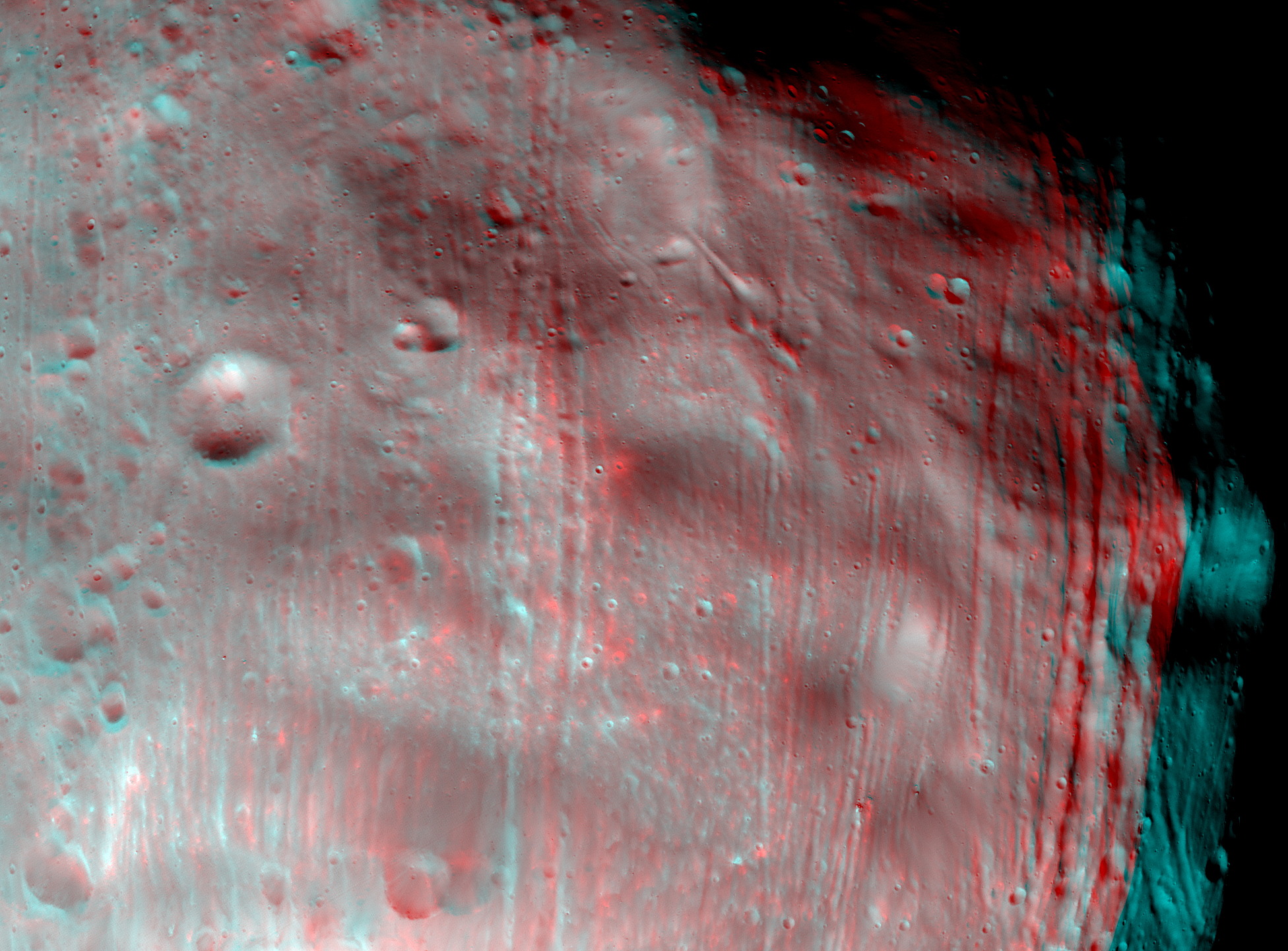
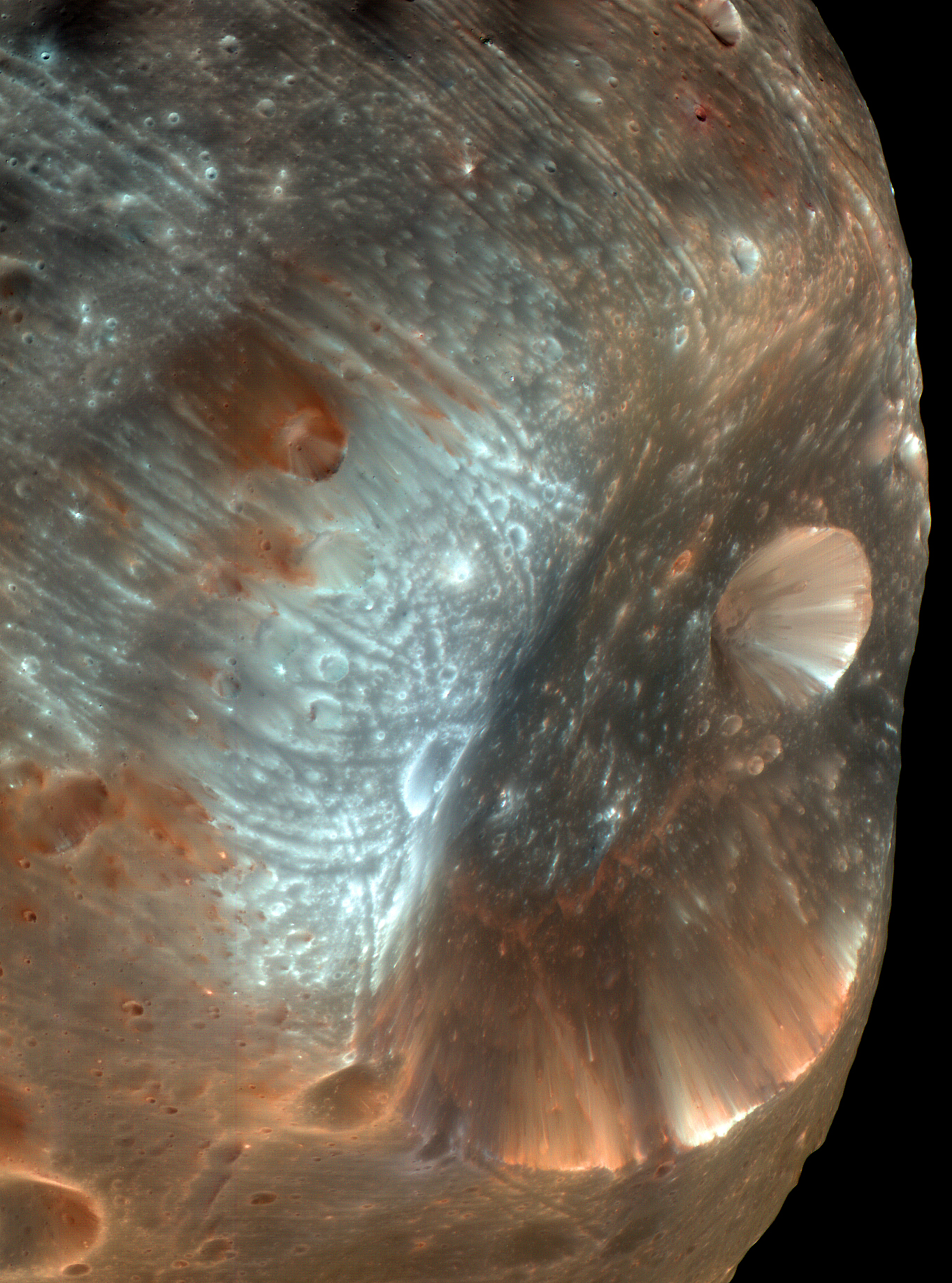
HiRISE acquired two dramatic views of the Martian moon, Phobos, on 23 March 2008. Observation PSP_007769_9010, acquired at a distance of 6,800 kilometers from Phobos, provides surface detail at 6.8 m/pixel scale and a object diameter of about 3,200 pixels. The second observation, PSP_007769_9015 providing a closer look at 5,800 km, views the surface at slightly more detail (5.8 m/pixel with an object diameter of about 4,000 pixels).

The two images were taken within 10 minutes of each other and show roughly the same features, but from a different angle so that they can be combined to yield a stereo view. (Watch a short clip of both observations: 204KB, QuickTime.)

The illuminated part of Phobos visible in the images is about 21 km across. Images from previous spacecraft have been of smaller pixel scale (for example, Mars Global Surveyor got data at 4 m/pixel, because this spacecraft came closer to Phobos), but the HiRISE images have greater signal-to-noise, making the new data some of the best ever for Phobos.

The most prominent feature in the images is the large impact crater Stickney, in the lower right. With a diameter of 9 km, it is the largest feature on Phobos. A series of grooves and crater chains is obvious on the other parts of the moon. Although many appear radial to Stickney in the images, previous studies show that the grooves radiate from a different point on Phobos. Hypotheses for their formation vary. Some scientists believe the grooves and crater chains are related to the formation of Stickney, whereas others think they may have formed from ejecta from impacts on Mars that later collided with Phobos. The lineated textures on the walls of Stickney and other large craters are landslides formed from materials falling into the crater interiors in the weak Phobos gravity (less than 1/1000th the gravity on Earth)

Found Here: http://hirise.lpl.arizona.edu/phobos.php


Here (below) are the "global" coordinates and orbital vector for this ESA Phobos image -- as prepared by Enterprise Associate, Greg Ahrens ....

An extraordinary, geometric, clearly artificial, fractured 3-D surface ... lying just beneath the veneer of "battered, ancient asteroid stuff" that Phobos presents from most other viewing angles -- all now stunningly revealed (below) ... in this high-resolution Mars Express Phobos "face-on" image!

So ... what are these obvious (see below) "grooves of Phobos?"

This fascinating mystery ... evident in the Viking images (above) as "a series of obvious, long, narrow and mysteriously-straight striations ..." -- running parallel across almost the entire visible width of this ~15-mile-wide moon -- was eventually interpreted by NASA as merely "crater-chains of secondary meteor impacts ... caused by Phobos intersecting [running into] such meteor streams ... blasted-out across Phobos' orbit ... as fragments from primary asteroid or comet impacts down on Mars' surface ...."

Now, from this latest Mars Express ultra-high-resolution imaging ( below) -- the REAL cause of these mysterious "grooves on Phobos" is readily, geometrically apparent--

Phobos -- as a clearly "artificial moon"--

"Is literally ... Coming Apart at the Seams!"

Because of the increasing, shearing gravitational forces -- caused by its slow "death spiral" into Mars--

Because of the inevitable--

"Tides ... of Mars."

So yes, what you are staring at (probably, in shock at this point ...) is, in fact ... nothing less than what we've been saying all along ... since trying to educate the first Bush Administration on this data, in 1989 (see below):

That Phobos is, in fact--

An "ancient ... ex terrestrial ... very battered ... 15-mile-long"--

Spaceship.

Exactly like ... "Yonada."

Which now (according to our European sources -- backed up by the actual Mars Express data itself, which you will see more of - below) ESA is about to officially ... publicly announce!

Possibly -- even before President Obama's up-coming ... suddenly-called ... STILL super-secret "Space Summit"--

Which is scheduled to take place, within a few days, at the Kennedy Space Center -- personally hosted by the President of the United States of America -- in the middle of an on-going shuttle mission--

STS-131.

Which, turns out to be ... the 33rd Space Shuttle Mission ... to the Space Station ("ISS").

Can you say "the Fix is in" ... for "something?"

Found Here: http://gazbom.blogspot.com/2010/04/old-space-station-destroyed-in-battle.html


Sunday, November 2, 2008

Violent Polar Cyclones on Saturn Imaged in Unprecedented Detail by Cassini


The Cassini mission has released some of the most detailed images of Saturn's poles yet, revealing vast cyclones churning up the gas giant's atmosphere in the north and south. These observations show very similar storms to the south pole observations imaged by the NASA spacecraft in 2006, only in far better detail. It is believed the north and south cyclones are generated by violent thunderstorms deep inside Saturn's atmosphere; water condensing inside these storms output heat, fuelling the vortex extending 2,500 miles (4,000 kilometres) in diameter. The smallest features resolved are 120 kilometre (75 mile)-wide cumulus clouds rotating at velocities in excess of 325 mph (530 kph), more than twice the wind speed possible on Earth

and the mystery north pole hexagon is still there.

Cassini has wowed scientists with these brand new views of Saturn's north pole. With detail at 10-times higher resolution than previously attained, Cassini has shown that both poles have vast swirling cyclones that highlight regions of planet-wide storm activity.

"These are truly massive cyclones, hundreds of times stronger than the most giant hurricanes on Earth," said Kevin Baines, Cassini scientist on the visual and infrared mapping spectrometer at NASA's Jet Propulsion Laboratory. "Dozens of puffy, convectively formed cumulus clouds swirl around both poles, betraying the presence of giant thunderstorms lurking beneath. Thunderstorms are the likely engine for these giant weather systems."

Interestingly, the northern storm observation still shows the mysterious hexagonal shape (as originally verified in 2006, after a sighting by Voyager 1 in 1980), only in far greater detail. Scientists are still uncertain why the northern cyclone should take such a stable form; the clouds within the hexagonal shape spin at high speeds without interfering with its six-sided shape.

Previous observations appeared to show an outer ring of high clouds surrounding a region thought to be clear air with a few puffy clouds circulating around the pole. These brand new images reveal a far more complex picture. The circulating clouds are actually smaller convective storms forming other, more distinct rings.

Found Here: http://www.universetoday.com/