Showing posts with label world history. Show all posts

Saturday, October 9, 2010

GEOLOGIC TIME SPIRAL - A Path to the Past

GEOLOGIC TIME SPIRAL (overleaf), showing the sequence, names, and ages of the geologic periods and epochs, and the evolution of plant and animal life on land and in the sea. The primitive animals that evolved in the sea during the vast Archean and Proterozoic Eons left few traces in the rocks because they had not developed hard parts, such as shells, but hard-shell or skeletal parts became abundant during and after the Cambrian Period. This drawing was made when the Geological Survey and most others used the term Precambrian to embrace what is now included in the Archean and Proterozoic Eons. The end of the Archean Eon and beginning of the Proterozoic Eon has been placed at about 2,500 million years ago. Also, because of more recent radiometric dating, the ages of the boundaries between some of the geologic periods and epochs have been changed slightly. Of most concern to this report, the boundary between the Pliocene and Pleistocene Epochs has been changed from 3 million to 2 million years. Drawn by John R. Stacy originally for inclusion in a report by Newman (1976). (click on image for an enlargement in a new window)

The Earth is very old—4.5 billion years or more according to scientific estimates. Most of the evidence for an ancient Earth is contained in the rocks that form the Earth's crust. The rock layers themselves—like pages in a long and complicated history—record the events of the past, and buried within them are the remains of life—the plants and animals that evolved from organic structures that existed 3 billion years ago.

Also contained in rocks once molten are radioactive elements whose isotopes provide Earth with an atomic clock. Within these rocks, "parent" isotopes decay at a predictable rate to form "daughter" isotopes. By determining the relative amounts of parent and daughter isotopes, the age of these rocks can be calculated. Thus, the scientific evidence from rock layers, from fossils, and from the ages of rocks as measured by atomic clocks attests to a very old Earth.

See USGS Fact Sheet 2007-3015 at http://pubs.usgs.gov/fs/2007/3015/ for ages of geologic time periods. Ages in the spiral have been rounded from the age estimates in the Fact Sheet. B.Y., billion years; M.Y., million years. For more information, see the booklet on Geologic Time at http://pubs.usgs.gov/gip/geotime/.

Product Type: Poster
Date created: 2009-05-22
Time created: 18:01:24
Color: Full Color
Page Size: 20 x 24
Finish: Non-Glossy
Orientation: Portrait

Tuesday, September 14, 2010

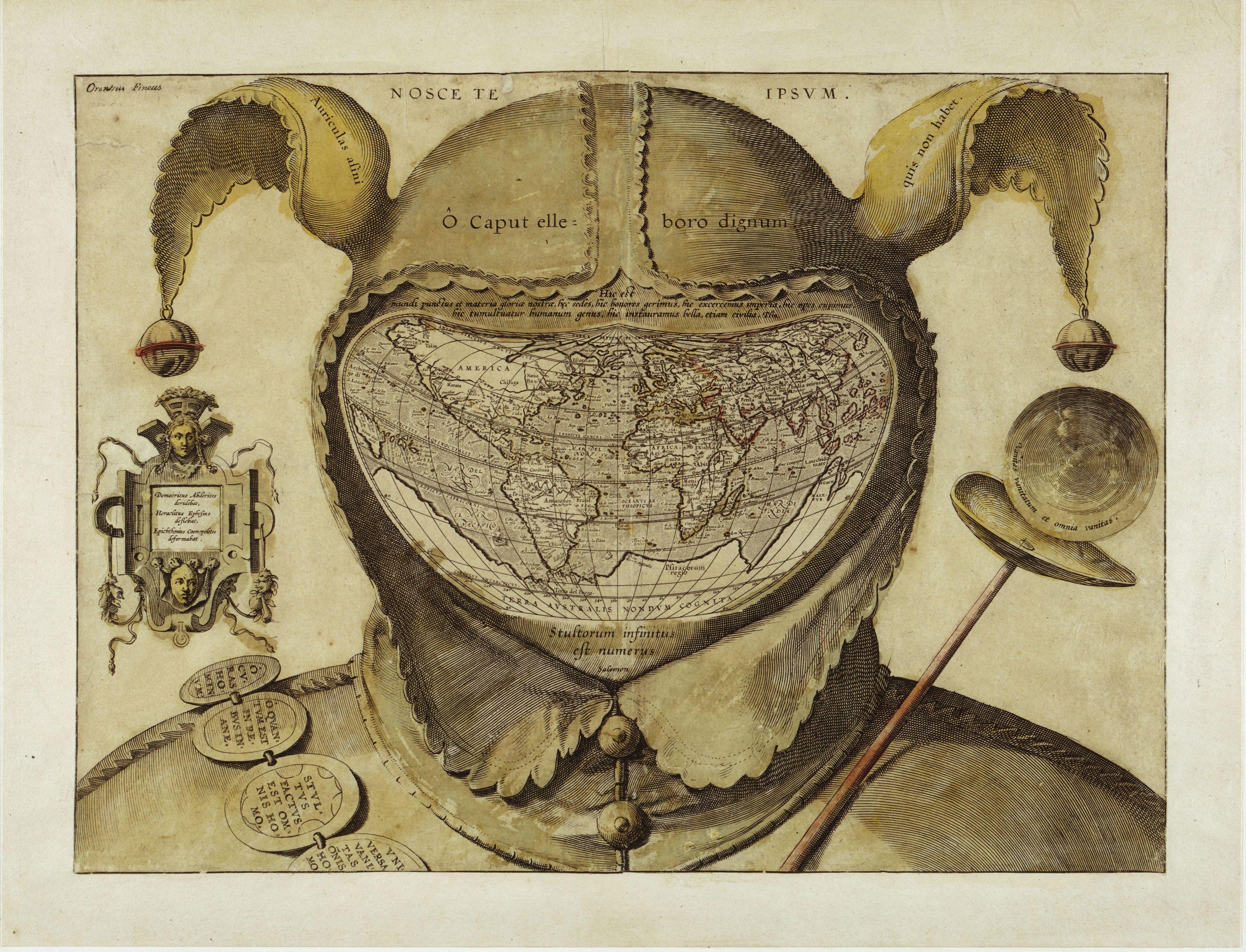
Fool’s Cap Map of the World

Fool’s Cap World Map

This startling and disturbing image is one of the enigmas of cartographic history. The artist, date and place of publication are all unknown, and one can only guess at its purpose. The geography of the map strongly resembles that of the world maps of Ortelius published in the 1580s, giving a tentative date of c. 1590. This is the earliest known use of the world map in a visual joke. Its central visual metaphor is the universality of human folly and various mottoes around the map reinforce that theme. The panel of the left says: “Democritus laughed at it [i.e. the world], Heraclitus wept over it, Epichtonius Cosmopolites portrayed it.” Although Epichtonius Cosmopolites appears to be the author’s or artist’s name, it translates roughly as “Everyman,” leaving the mapmaker’s true identity hidden.

A strong legacy of the theme of the Fool exists in literature and popular art from the fourteenth to seventeenth centuries. The Fool was licensed to break rules, speak painful truths and mock power and pretension, and the grotesque shape he bore was a kind of living punishment. This frame of reference would have been quite familiar to the audience of this engraving in the 1590s. And people would have recognized in this map a radical visual interpretation of the Fool’s role: it is now the whole world that takes on the Fool’s costume, thus forcing the viewer to confront the possibility that the entire created order is irrational, alien and threatening.

Adapted from the book The Image of the World: 20 Centuries of World Maps by Peter Whitfield (Pomegranate Artbooks, 1995)


Found Here: http://myweb.dal.ca/jpekacz/maps.html

This rather sinister image is one of the biggest mysteries in the history of western cartography. Most often referred to simply as the Fool’s Cap Map of the World, it is unknown why, when, where and by whom it was made.

The only thing that can be said about it with some certainty is that it dates from ca. 1580-1590. But sources even differ as to the type of projection used, some referring to it as ptolemaic (i.e. equidistant conic), others claiming it owes more to the techniques of Mercator and/or Ortelius (and being an enthusiast rather than a specialist, I’m not one to call this).

The map shows the world ‘dressed up’ in the traditional garb of a court jester: the double-peaked, bell-tipped cap (1) and the jester’s staff (2). The face is hidden (or replaced) by the map, giving the whole image an ominous, threatening quality that feels anachronistically modern.


The archetype of the Fool, presented here in his incarnation as the court jester, is a first indicator of the map’s deeper meaning. In previous ages, the Fool was a court figure allowed to mock majesty and to speak truth to power. These were rare and useful correctives to the corrupting absolutism of the monarchies of the day. But criticism of this sort was only possible if it was de-fanged by the grotesque appearance of the Fool - preferably a hunchbacked, slightly loopy-headed dwarf, i.e. someone not to be taken too seriously.

All of this would have been common and current knowledge to the people viewing this map, in the late 16th century. The uncomfortable truth told by this map is that the world is a sombre, irrational and dangerous place, and that life on it is nasty, brutish and short. The world is, quite literally, a foolish place.

This is underlined by the mottoes of biblical and classical origin, dotted across the map. The

legend in the left panel reads: “Democritus of Abdera laughed at [the world], Heraclitus of Ephesus wept over it, Epichtonius Cosmopolites portrayed it” (3). Over the cap is the Latin version of the Greek dictum, “Know thyself" (4). Across the cap’s brow, the inscription translates as “O head, worthy of a dose of hellebore” (5).

The Latin quote just above the map is from Pliny the Elder (6): “For in the whole universe the earth is nothing els e and this is the substance of our glory, this is its habitation, here it is that we fill positions of power and covet wealth, and throw mankind into an uproar, and launch wars, even civil ones.”

The reason for so much trouble and strife is explained in the quote below the map, from Ecclesiastes: “The number of fools is infinite” (7). Another quote from that most depressing of Bible books, on the jester’s staff to the right, intones: “Vanity of vanities, all is vanity” (8). Inscribed on the badges adorning the shoulder belt are a few sayings in line with this cheerful message: “Oh, the worries of the world; oh, how much triviality is there in the world” (9), “Everyone is without sense” (10), and “All things are vanity: every man living” (11).

For some researchers, the sum of these messages, as well as their presentation in a cartographic setting, point to a little-known Christian sect called the Family of Love. This clandestine group is said to have numbered the Flemish cartographer Ortelius in its ranks. If this map is anything to go by, the Family of Love must have espoused a rather harsh and pessimistic view of the world, and of humanity’s place in it.

But much remains conjecture, as indicated also by the last piece of this cartographic puzzle - the name written in its top left corner: Orontius Fineus. This name (the Latinised version of the French name Oronce Finé) is associated with a map dated 1531, purportedly showing an ice-free, river-rich Antarctica. Why would the name of this cartographer crop up on a map made decades later? Could he have been the mapmaker (12)? Or is he the one being made fun of?

Many thanks to J.B. Post for alerting me to this map. Many versions to be found online, this high-resolution image found here at Coin des cartes anciennes.

------------------------------------------------------------------------------------------------------------------

(1) the donkey’s ears referring to the supposed stupidity of the ass. Inscribed on them is the quote Auriculas asini quis non habet, meaning “Who doesn't have donkey's ears?" This witticism is ascribed to Lucius Annaeus Cornutus, a Roman stoic philosopher from the 1st century AD.

(2) a parody of the royal staff, a symbol of authority.

(3) Democritus Abderites deridebat, Heraclites Ephesius deflebat, Epichthonius Cosmopolitus deformabat. Epichtonius Cosmopolites seems to refer to the maker of the map, but actually means something like ‘Everyman’.

(4) Nosce te ipsum, in Greek: gnothi seauton. According to Pausanias, an inscription on Apollinic temple at Delphi.

(5) O caput elleboro dignum. Hellebore is a family of mostly poisonous plants, some of which have been used medicinally since Antiquity. It is reputed to induce madness.

(6) Hic est mundi punctus et materia gloriae nostrae, hic sedes, hic honores gerimus, hic exercemus imperia, hic opes cupimus, hic tumultuatur humanum genus, hic instauramus bella, etiam civica. From Book 2, Chapter 72 of the Naturalis Historia (‘Natural History’) by Caius Plinius Secundus.

(7) Stultorum infinitus est numerus (Ecc. 1:15).

(8) Vanitas vanitatum et omnia vanitas (Ecc. 1:2).

(9) O curas hominum, O quantum est in rebus inane, the opening quote of Aulus Persius Flaccus’ Satires.

(10) Stultus factus est omnis homo (Jer. 10:14).

(11) Universa vanitas omnis homo (Psalm 39:6).

(12) Not likely; his dates are 1494-1555. Or could the map predate its estimate by about 30 years?

Found Here: http://bigthink.com/ideas/24015?ref=nf

Friday, July 30, 2010

Intelligence in Lifestyle Magazine

Intelligence in Lifestyle or IL is a relatively young Italian magazine about contemporary passions and consumptions. It premiered in September of 2008, and like T Magazine, the style supplement of The New York Times, IL is the supplement to the Italian newspaper Il Sole 24 ORE. The design takes inspiration from Swiss formalism, fashion magazines, and popular Italian & Northern European periodicals from the 70s. As for the content, I only wish I could read Italian. For now, I’ll just pore over the layout, typography, and infographics—oh my, the infographics—I’m a huge fan of Feltron—but egad, these ones are amazing.

Francesco Franchi, one of the art directors for IL, archives all the covers and various interiors on his Flickr feed, and you can view them in much higher resolutions. I couldn’t quite figure out the serif font used throughout the magazine, and Francesco was kind enough to identify it for me: Publico, released under the foundry Commercial Type and designed by Paul Barnes, Christian Schwartz, Kai Bernau, and Ross Milne. It’s sexy and elegant and not nearly as ubiquitous as say, Helvetica or more recently, Archer.

Other things I love about IL:

  • Cover design consistency
  • The cutout of the IL logotype on the cover
  • The perfect combination of serif and sans serif type
  • The use of color as part of a theme, complementary to the content

I just want to dismantle the whole thing and hang the pages up as framed art.

Found Here: http://colorcubic.com/2010/04/21/intelligence-in-lifestyle-magazine/

Intelligence in Lifestyle magazine is the new holy grail of infographic greatness. It is a high-end Italian magazine aimed at men. The magazine is equipped with a beautiful design by the art director Francesco Franchi and the creative director Luca Pitoni.

For some of us, getting ahold of the magazine could be difficult. However, several several of the layouts from the interiors spreads and covers are archived on Flickr. Check out the larger sizes, they may compliment your desktop nicely. If in case you’re wondering, the magazine utilizes Publico, a serif face that fits perfectly into the design is much less ubiquitous than say Helvetica or Archer.

On another note prior to being introduced to this magazine via Colorcubic, I was starting to become overwhelmed by the amount of infographics being pumped into the designosphere. Infographics about infographics were being designed for crying out loud. It just seems like it has become trendy very quickly. It’s not to say its a bad thing, but it sure makes me appreciate great design like in this magazine or Nicholas Felton’s works more than ever before.

I’m curious to hear what your thoughts are on this topic.
Do you feel there is an influx of infographics and is it a good or bad thing?

Found Here: http://blog.iso50.com/2010/06/01/intelligence-in-lifestyle-magazine/

Tuesday, January 26, 2010

The Holocaust | Pentagram | Burnt Offering | Ritual Mass Human Sacrifice

The word "holocaust" originally derived from the Greek word holokauston, meaning "a completely (holos) burnt (kaustos) sacrificial offering", or "a burnt sacrifice offered to a god". In Greek and Roman pagan rites, gods of the earth and underworld received dark animals, which were offered by night and burnt in full. The word "holocaust" was later adopted in Greek translations of the Torah to refer to the olah[3], standard communal and individual sacrificial burnt offerings that Jews were required[4] to make in the times of the Beit HaMikdash (Temple in Jerusalem).

Found Here: http://en.wikipedia.org/wiki/Names_of_the_Holocaust


Many who will read or hear excerpts of the previous article about the Vatican-Jesuit Holo
caust will remain unconvinced, if not horrified by the claims which its contains.

The claim that a three hundred mile (plus) wide Pentagram of supreme evil can be formed by the precise true geographic location of the worst Nazi Human Sacrifice Camps of WWII will strike many as the “imagination” of conspiracy writers – the same fanciful notion as those who would see religious symbols in simple pieces of toast, or clouds.

Yet the Pentagram is able to be drawn and at its precise center of power is an actual Temple dedicated to Cybele- otherwise known as Inaana, Ishtar and Sibyl --the most ancient goddess whose most sacred site is Vatican Hill. So it is not something that can be discounted entirely.

Logic is a critical tool in the search for truth – what is mere fable and sometimes wild slander – and what makes common sense, sounds reasonable and probable. But what is even more important that a logical perspective is a respectful one.

When anyone mentions World War II and the slaughter of innocents by Roman Catholic Dictators and their allies, we are discussing an event of unprecedented evil. Therefore, uptmost care must be given to respecting their memory and surviving families. Any claim needs to be provable - unquestionably factual and not
reckless, unfounded theories.

To answer any outstanding doubt concerning the complete involvement of the Roman Catholic Church through Pope Pius XII and Jesuit Superior General Wladimir Ledochowski S.J., let us examine some additional evidence concerning the Pentagram, the satanic religious nature of sacrificing over eighteen million people.

Found Here: http://continuingcounterreformation.blogspot.com/2009_01_01_archive.html


(Secret) Knowledge is Power

The evidence of who won the Jesuit Civil War is all around us. Universities have blossomed. Science discovery has accelerated and knowledge is universally accepted as power—the power of imagination and the era of the United States. The New World Order won the Civil War and remain firmly in control.


In terms of key satanic knowledge that relates to their power, the secret knowledge of the Great Vatican-Jesuit Pentagram of Evil is very important knowledge, forgotten by many. So too, is the clear and unmistakable image “makeover” of evil from satan and “the devil” to Lucifer- or the spirit of Francis Borja personified as evil.


It is why Borja ordered every church to ever be built by the Jesuits in following years to be constructed under strict codes of similar design—every Jesuit church was purpose built to be a readymade temple to Lucifer -- to the spirit of Francis Borja, the real founder of the Jesuits.


Similarly, human sacrifice to the satanic gods became more sophisticated, starting with the atomic bombs on Japan. No longer did the New World Order Jesuits need massive and expensive human sacrifice camps to “burn” millions of victims, one tiny bomb could do it in seconds.


One of the greatest criminal acts in history remains the executive order by President Truman to drop the atomic bombs on Hiroshima and disgraced Jesuit city Nagasaki in 1945 after receiving not one, but several official notices of surrender from the Japanese. Thus began the “modern” age of sacrifice to the satanic gods of the Vatican and Jesuits.
Found Here: http://one-evil.org/acts_holocaust/acts_vatican_holocaust_part_4.htm

Monday, April 27, 2009

sculpture source:life

The history of the sculpture is varied and is illustrative of how sculpture has changed extensively over the ages. The art of sculpture continues as a vital artform worldwide. From pre-historic and ancient civilizations to the contemporary, from the utilitarian and religious to Modernist abstraction, and conceptual manifestations of both form and content, a continuous stream of creativity & an extremely modest show of compassion.

Sculpture has been central in religious devotion in many cultures, and until recent centuries large sculptures, too expensive for private individuals to create, were usually an expression of religion or politics. Those cultures whose sculptures have survived in quantities include the cultures of the Ancient Mediterranean, India and China, as well as many in South America and Africa. Moses's rejection of the Golden Calf was perhaps a decisive event in the history of sculpture. Aniconism remained restricted to the Jewish, Zoroastrian and some other religions, before expanding to Early Buddhism and Early Christianity, neither of which initially accepted at least large sculptures. In both Christianity and Buddhism these early views were later reversed, and sculpture became very significant, especially in Buddhism. Christian Eastern Orthodoxy has never accepted monumental sculpture, and Islam has consistently rejected all figurative sculpture. Many forms of Protestantism also do not approve of religious sculpture. There has been much iconoclasm of sculpture from religious motives, from the Early Christians, the Beeldenstorm of the Protestant Reformation to the recent destruction of the Buddhas of BamyanTaliban. by the

Sculpture in ancient times

Sculpture as an art form goes back to Prehistoric times. Most Stone Age statuettes were made of ivory or soft stone, however some clay human and animal figures have been found. Small female statues known as Venus figurines have been found mainly in central Europe. The Venus of Willendorf (24,000-22,000 BC), from the area of Willendorf, Austria, is a well-known example.

Later, in the Near East, (the area between the Tigris and the Euphrates Rivers), the Sumerian, Akkadian, and Babylonian kingdoms flourished. Materials used for sculpture during this time included basalt, diorite (a type of dark, coarse-grained stone), sandstone, and alabaster. Copper, gold, silver, shells, and a variety of precious stones were used for high quality sculpture and inlays. Clay was used for pottery and terra cotta sculpture. Stone was generally rare and had to be imported from other locations.

Sculptures from the Sumerian and Akkadian period generally had large, staring eyes, and long beards on the men. Votive stone sculptures of this type from 2700 BC were discovered at Tell Asmar. Many masterpieces have also been found at the Royal Cemetery at Ur (2650 BC). Among them are a wooden harp with gold and mosaic inlay with a black-bearded golden bull's head.

Social status

Nuremberg sculptor Adam Kraft, self-portrait from St Lorenz Church, 1490s.

Worldwide, sculptors have usually been tradesmen whose work is unsigned. But in the Classical world, many Ancient Greek sculptors like Phidias began to receive individual recognition in Periclean Athens, and became famous and presumably wealthy. In the Middle Ages, artists like the 12th century Gislebertus sometimes signed their work, and were sought after by different cities, especially from the Trecento onwards in Italy, with figures like Arnolfo di Cambio, Nicola Pisano and his son Giovanni. Many sculptors also practised in other arts, sometimes painting, like Andrea del Verrocchio, or architecture, like Giovanni Pisano, Michelangelo, or Jacopo Sansovino, and maintained large workshops.

From the High Renaissance artists like Michelangelo, Leone Leoni and Giambologna could become wealthy, and ennobled, and enter the circle of princes. Much decorative sculpture on buildings remained a trade, but sculptors producing individual pieces were recognised on a level with painters. From at least the 18th century, sculpture also attracted middle-class students, although it was slower to do so than painting. Equally women sculptors took longer to appear than women painters, and have generally been less prominent until the 20th century at least.

Found Here: http://en.wikipedia.org/wiki/History_of_sculpture


Saturday, February 7, 2009

Another "vision" of history | Maurillo Manara (Milo Manara)

Another "vision" of history

Raúlo En: Raul: Dibujo Drawing Arte Arts Sociedad Society Actualidad Today Historia de la Humanidad History of Humanity Cultura Culture

El dibujo y la historia Drawing and story

Una curiosa guía visual de la evolución de la humanidad a través del tiempo historico del gran maestro italiano Maurillo Manara (Milo Manara) . A strange visual guide to the evolution of humanity through time of great historical Italian master Maurillo Manara (Milo Manara). Es uno de los dibujantes más famosos del panorama erótico mundial. It is one of the most famous cartoonists picture erotic world. Las mujeres de Manara son esculturas en sí mismas y sus historietas son clásicos entre los clásicos del género. Women of Manara are sculptures in themselves and their stories are classics among classics of the genre.
Su primer título, Genius , lo publicó en 1969. His first title, Genius, published in 1969. El sexo y la aventura ya despuntaron como ingredientes fundamentales de su obra. Sex and adventure and emerged as key ingredients of his work.
Con " HP y Giusseppe Bergman" se situó entre los mejores autores de cómic de autor. With HP and Giuseppe Bergman "was among the finest comic authors of the author. A partir de ahí Manara creció con un género que poco a poco se hizo suyo. "El Clic" fue un gran éxito de ventas y crítica. From there Manara a genre that grew gradually became his. "Click" was a huge critical and sales success. Luego vendrían "Verano Indio" (con guión de Hugo Pratt), "El Perfume del Invisible" y las sagas de "HP y Giusseppe Bergman" y "El Clic". Fue estrecho colaborador del maestro del cine Federico Fellini. Then came "Indian Summer" (with script by Hugo Pratt), "The Perfume of the Invisible" and the saga of "HP and Giuseppe Bergman" and "Click." It was a close associate of the maestro Federico Fellini film.

La "evolución", segun Milo... The "evolution", according to Milo ...

Otra de sus historias más famosas es:"City Hunters" explora a fondo el mundo de la seducción a través de la historia de un maestro y un aprendiz en el arte de la conquista femenina. Another of his most famous stories is "City Hunters" explores in depth the world of seduction through the story of a master and an apprentice in the art of female conquest.

"City Hunters" gira en torno a Axel, un joven melancólico quien ha sido abandonado por su novia y al Dr. Lynch, un viejo bon vivant, quién en los años ´70s fue un maestro creador de fragancias masculinas y playboy. "City Hunters" around Axel, a melancholy young man who was abandoned by his girlfriend and Dr. Lynch, an old bon vivant, who in the'70s was a master creator of fragrances and male playboy.
Según presume, Lynch es miembro y actual guardián de la Logia X, una agrupación ultra-secreta que desde hace más de 2 mil años, se dedica a investigar a la mujer y todo lo relacionado con el misterioso mundo del arte de la seducción. According presumed Lynch is a member and current custodian of the Lodge X, an ultra-secret group that for more than 2 thousand years, is dedicated to research on women and everything about the mysterious world of the art of seduction.
En un accidente, Lynch conoce a Axel y súbitamente detecta en él un fuego sagrado, un verdadero diamante en bruto y comienza a considerar que tal vez sea Axel el indicado para transmitir los secretos de la logia a la próxima generación. In a crash, Lynch met Axel and suddenly find it a sacred fire, a real diamond in the rough and begins to consider that perhaps Axel suitable for transmitting the secrets of the lodge to the next generation. Antes, Axel deberá convertirse en un "Seductor Absolutis": un hombre capaz de conquistar a cada una de las distintas tipologías de mujer que existen. Earlier, Axel should become a "Seductive Absolutis": a man capable of conquering each of the different types of women that exist. ( este comics fue la base para la campaña de Axe ,si el desodorante!!) RG. (This comic was the basis for the campaign Ax, if the deodorant!) RG.