Showing posts with label printmaking. Show all posts

Friday, December 16, 2011

Maps - Heights of Mountains, Lengths of Rivers

For over 100 years, atlas and map publishers in the United States and Europe published a style of map that was a visualization of the heights and lengths of the world's mountains and rivers. Some of the earliest examples appeared in Europe towards the end of the 18th century. In the United States, the form was popular throughout the 19th century and the early part of the 20th. These maps appeared in atlases, as wall maps, and as pocket maps. One of the most elegant examples was engraved originally on copper by map publisher Henry Tanner in Philadelphia in 1836 and then continued by S. Augustus Mitchell, also of Philadelphia, in lithographic versions into the 1850's.

The Mountains and Rivers maps appeared in several styles and formats. One of the earliest styles was to show just mountains, piled up in a landscape, with a key of mountain heights on the left and right sides of the illustration. Also listed on the side would be the highest flights of the Condor, limits of plants and trees, elevations of lakes, elevation of certain high altitude cites, and climate zones. An early example in the Rumsey collection is Charles Smith's Comparative View of the Heights of the Principal Mountains &c. In The World, published in London in 1816.

Another popular style combined heights of mountains and lengths of rivers in one view. The rivers are stretched out in single lines, with the longest on the left combining with the shortest mountains, while the shortest rivers combine with the highest mountains on the right. The visual result is very compelling. One of the earliest examples was W.R. Gardner's Comparative Heights of the Principal Mountains and Lengths of the Principal Rivers, published by William Darton in London in 1823.


A third variation of the mountain and rivers designs was putting the mountains in the center of the view with the rivers extending downward on each side. One of the earliest examples of this type was published by Henry Tanner in 1836, Heights of the Principal Mountains in the World.

John Dower and Henry Teasdale published another version in London in 1844 titled Principal Mountains and Rivers of the World. It is possible that there was an earlier version of this London map that Tanner copied from - a common practice of American mapmakers in the first half of the 19th century - but Tanner's map is centered on information important to American readers and the Dower/Teasdale map is oriented to England and Europe.

Gray's new map of the World in hemispheres, with comparative views of the heights of the principal mountains and lengths of the principal rivers on the globe, of 1885, provided a simplified view of the mountains and rivers. It appeared in George N. Colby's Atlas of the State of Maine, 1885.

Found Here: http://www.davidrumsey.com/blog/2009/9/5/heights-of-mountains-lengths-of-rivers


earliest known map is a matter of some debate, both because the definition of "map" is not sharp and because some artifacts speculated to be maps might actually be something else. A wall painting, which may depict the ancient Anatolian city of Çatalhöyük (previously known as Catal Huyuk or Çatal Hüyük), has been dated to the late 7th millennium BCE.[1][2] Other known maps of the ancient world include the Minoan "House of the Admiral" wall painting from c. 1600 BCE, showing a seaside community in an oblique perspective and an engraved map of the holy Babylonian city of Nippur, from the Kassite period (14th – 12th centuries BCE).[3] The oldest surviving world maps are the Babylonian world maps from the 9th century BCE.[4] One shows Babylon on the Euphrates, surrounded by a circular landmass showing Assyria, Urartu[5] and several cities, in turn surrounded by a "bitter river" (Oceanus), with seven islands arranged around it.[6] Another depicts Babylon as being further north from the center of the world.[4]

The ancient Greeks and Romans created maps, beginning at latest with Anaximander in the 6th century BC.[7] In the 2nd century AD, Ptolemy produced his treatise on cartography, Geographia.[8] This contained Ptolemy's world map - the world then known to Western society (Ecumene). As early as the 8th century, Arab scholars were translating the works of the Greek geographers into Arabic.[9]

In ancient China, geographical literature spans back to the 5th century BC. The oldest extant Chinese maps come from the State of Qin, dated back to the 4th century BC, during the Warring States Period. In the book of the Xin Yi Xiang Fa Yao, published in 1092 by the Chinese scientist Su Song, a star map on the equidistant cylindrical projection.[10][11] Although this method of charting seems to have existed in China even prior to this publication and scientist, the greatest significance of the star maps by Su Song is that they represent the oldest existent star maps in printed form.

Early forms of cartography of India included the locations of the Pole star and other constellations of use.[12] These charts may have been in use by the beginning of the Common Era for purposes of navigation.[12]Mappa mundi is the general term used to describe Medieval European maps of the world. Approximately 1,100 mappae mundi are known to have survived from the Middle Ages. Of these, some 900 are found illustrating manuscripts and the remainder exist as stand-alone documents.[13]

The Arab geographer Muhammad al-Idrisi produced his medieval atlas Tabula Rogeriana in 1154. He incorporated the knowledge of Africa, the Indian Ocean and the Far East, gathered by Arab merchants and explorers with the information inherited from the classical geographers to create the most accurate map of the world up until his time. It remained the most accurate world map for the next three centuries.[14]

In the Age of Exploration, from the 15th century to the 17th century, European cartographers both copied earlier maps (some of which had been passed down for centuries) and drew their own based on explorers' observations and new surveying techniques. The invention of the magnetic compass, telescope and sextant enabled increasing accuracy. In 1492, Martin Behaim, a German cartographer, made the oldest extant globe of the Earth.[15]

Found Here: http://en.wikipedia.org/wiki/Cartography


Wednesday, June 29, 2011

Melencolia I (1514) by Albrecht Dürer

Conjectures and theories about Dürer’s solid: an overview

(See also “A new link between Melencolia I and the golden ratio” and “A Melencolia sequel: tracing Dürer’s point of view”)

The copper engraving “Melencolia I” (1514) by the German Renaissance artist Albrecht Dürer (1471 – 1528) remains one of the most enigmatic works in the history of Art. At first view, the composition seems as a jumble of apparently unrelated objects, some of which cannot even be recognized or named. Behind the first layer of perception, that the eye catches immediately, a closer inspection reveals smaller objects, chaotically scattered or even half hidden.

The picture is dominated by a sitting angel, presumably feminine but muscular, whose glance is fixed somewhere in the distance. With her right hand she holds a seemingly idle pair of compasses, while with her left hand she supports her head, gloomy faced, as if dried up of inspiration. At her feet, and half hidden underneath her long garment, lay several carpenter’s tools: a plane, a pair of pliers, a saw and some nails. On her right, a putto sits on a round millstone or grindstone, occupied with scribbling something on a small board fixed on his knees, hiding his work from the viewer with his left hand. Remarkably, the millstone seems to have an axle socket slightly off – centered. Diametrically of the angel stands a large geometric solid, which we will refer to as “the Dürer solid” in this essay. Only four faces of the solid can be seen from the viewer’s point of view. In front of the solid, a dog is calmly rolled up before a sphere. In the background of all these stands what seems to be part of a building, two walls meeting seemingly perpendicularly and fixed on them appear a balance, a hourglass and a bell. A magic square is inscribed on the wall facing the viewer: a square arrangement of the numbers 1 to 16 such as the sum of each row, column and diagonal is equal to 34. A ladder leans on the wall behind the structure while far in the horizon, through the only part of the composition which is not crammed with objects, providing thus an unobstructed view, some sea or lake can be seen and even the houses of some village on its shores. A luminous celestial object on the night sky, possibly a comet, sheds light over the landscape, which is covered by a bright arc, resembling a lunar rainbow. And against the sky, over the whole composition of objects, earthly and heavenly, hovers an imaginary bat – like creature, having only two clawed front legs and the tail of a lizard. The creature stretches its body and its wings to reveal, as if tattooed on its own skin, the inscription “Melencolia§I”.

The conundrum presented by the engraving has been studied extensively in the past by many researchers, and several different interpretations have been offered. Most of these are attempts to guess Dürer’s own intentions, while some could even be described as wild guesses or long shots. Sometimes the interpretations given are not very different from the interpretations of a rather abstract poem: it seems that none of them is more or less “correct” than the others. Dürer has left for us a riddle whose answer is highly susceptible to subjectivity, without leaving any instructions on how this enigmatic work should be read after all. Only a few features of the picture are rather clear, such as the year 1514 appearing in the base row of the magic square. Dürer signed his work AD1514, giving himself the solution to this minor puzzle (note that AD stands for “Anno Domini” and “Albrecht Dürer” at the same time). The inverted 5 of the magic square is generally agreed that represents the month of the year 1514 in which Duerer’s mother died, an event undoubtedly linked to melancholy. It has been suggested that the magic square itself is borrowed from a talisman of the German occultist Heinrich Cornelius Agrippa von Netteshime (1486 – 1535). Cornelius Agrippa intended the talisman, or “Jupiter’s square”, as a shield from the bad influence of planet Saturn, which could cause melancholy (in medieval times, scholars associated Saturn with melancholy, one of the four humors of ancient medicine). This explanation is at least possible and reasonable, and is supported by the fact that Agrippa had visited Nurnberg, Dürer’s city, in 1510. Little else, if anything, about the picture has been resolved satisfactorily, let alone undoubtedly.

The comet, the bat – like creature, the landscape, the lunar rainbow, the building, the ladder, the scales, the hourglass, the bell, the putto, the millstone, the angel, the tools, the sphere have all been, and still are, subjects of guessing. Even the title of the work, “Melencolia I”, remains largely unresolved, partly due to the misspelled “melancholia” (in latin) and partly due to the mysterious “I”. Of special interest in this essay is the Dürer’s solid, the geometric object dominating the left part of the engraving. The proposed theories or conjectures about the solid can be distinguished in two categories. The first is comprised of theories about the exact geometric nature of the solid. The second collects all theories about the possible message the solid conveys or about what the solid stands for in the general context of “Melencolia I”.

Examining the first category, these are some of the proposed solutions of the riddle:

1. The truncated rhombohedron hypothesis: Most researchers agree that the solid is probably what in Solid Geometry is called a “truncated rhombohedron”. The name of it may seem somewhat repelling, however it is a rather simple solid with six faces, all of which are rhombi. A rhombus is a quadrilateral with all of its sides having the same length (by school Geometry it can be proved that it is also a parallelogram). The rhombohedron is a solid constructed by repeating a rhombus six times and looks like a dice whose angles are not right. A “truncated rhombohedron” is a rhombohedron with its two facing vertices cut off. It must be stressed that the assertion that the Dürer solid is a truncated rhombohedron is simply a conjecture and is not supported by any of Durer’s writings or by any other data. The only reason leading to a general agreement on the truncated rhombohedron hypothesis is that the Dürer’s solid simply looks like a truncated rhombohedron.

2. The truncated rhombohedron – 72° hypothesis: Some researchers have even made a step further, to assume that the angles of each face of the rhombohedron are 72 and 108 degrees (i.e. 1/5 and 3/10 of the full turn). Mathematically, these values are of special importance and link the Dürer’s solid to the notorious number φ, the ancient “golden ratio” or “golden mean”. Indeed, the above angles refer to a special kind of polygon, called a regular convex pentagon, which is a shape with five equal sides and five equal angles (all of them equal to 108 degrees). It can be proved that the chords of such a shape are in golden ratio to its sides.

3. The scaling hypothesis: It has also been argued that a vertical compression of the engraving by a factor sqrt(φ) turns the picture into a square and the solid into a truncated cube, providing thus another link to the golden ratio.

4. The truncated rhombohedron – 80° hypothesis: According to another point of view, resulting from measurements based on quantitative assumptions, the angle of the rhombohedron is approximately 80 degrees, which by mathematical standards is a rather humble number with no miraculous properties as the ones mentioned above.

5. The heptagon hypothesis: Despite the apparent humbleness of the number 80 mentioned above, it has been observed that it is suspiciously close to the number 77,2, which would be the value of an angle of the irregular pentagon produced if five of the seven vertices of a regular convex heptagon were joined.

6. The truncated rhombohedron – circumscribed sphere hypothesis: According to this theory, Dürer observed that while six of his rhombohedron vertices lie on the same sphere, the other two, those at the bottom and the top, stick out of it. In order to make his solid beautiful, the artist cut of the two protruding vertices in a way that the resulting truncated solid is circumscribed in a sphere. The theory is supported by the familiarity of the artist to the so called “plan and elevation” method, i.e. the using of projections of solids on planes, which would have been of great assistance in the process of the truncation.

7. The rectangular slab hypothesis: Apart from the rhombohedron conjecture, the Dürer’s solid has also been viewed as a nearly rectangular slab, or parallelepiped (a matchbox), with two opposite corners cut off.

8. The ambivalence hypothesis: This can be summarized in physicist David Finkelstein’s phrase “I propose that Dürer designed the Octahedron [meaning the solid] to be ambivalent, irresistibly construed as a truncated rhomboid in one orientation, as a truncated slab in another, and as something else from yet another”.

Number 1 of the above hypotheses may be traced to Erwin Panofsky (“The Life and Art of Albrecht Dürer”, 1943), a standard reference on Dürer. Numbers 2 and 6 have been proposed by Peter Schreiber (Historia Mathematica 26, 1999, 369 – 377). Numbers 5 and 7 are found in works by David Finkelstein, who attributes number 7 to personal communication with Dr. Basimah Khulusi, apparently a medical doctor. Number 4 has been proposed by C. MacGillavry (Mac Gillavry C., Nederl. Akad. Wetenschap. Proc. Series B 84, 1981, 287).

A number of explanations have been proposed about some meaning conveyed by the solid, or why Dürer included it in “Melencolia I”, putting it in such a prominent position. Some of these are:

1. The philosopher’s stone hypothesis: According to a point of view, the Dürer’s solid is a symbol, or image, of the medieval philosopher’s stone or the “stone of Saturn” (this is the same stone that, in ancient Greek mythology, Saturn swallowed instead of Jupiter). Such alchemic positions can be found in www.alchemylab.com.

2. The star of David hypothesis: David Finkelstein sees a Jewish star (a hexagram) of David on the projection of the solid on the ground. In his opinion the “circumcised rhomboid” is a sign of Hebraicism from Dürer’s part.

3. The human skull hypothesis: Many see a rather deformed human skull in the strange stain on the front face of the Dürer’s solid, with unclear meaning.

4. The four ghosts (or hidden faces) hypothesis: David Finkelstein again noticed in 2004 that “anyone who steps back several paces from a good print and focuses on the shading of the front face of the polyhedron patiently for a minute or so, will soon find or construct a face” which, by some sort of Necker’s cube illusion, could be at the same time either a man’s or a woman’s face. After mentioning that these faces may represent Dürer’s mother and father, Finkelstein denotes that “I am less certain of a third hidden face”. By 2008 Finkelstein had discovered two more faces on the solid which he claims first to have inferred and then found. His overall theory about “Melencolia I” is a medley of subliminal images, gematria, rebuses and anagrams, to arrive, as far as the solid is concerned, to the conclusion that it is a puzzle “unsolvable in principle but appears to solve itself in some views. It declares that the Intellectual World may have a mathematical design but, if so, that design is inaccessible to us”.

I must say that some of the above theories and explanations seem to be, to me at least, too farfetched and perhaps many of them did not cross Dürer’s mind, not even as a distant possibility. It must be taken into account that Dürer was an artist of the Renaissance era and, a genius as he might be and a master of the burin, his capabilities were certainly within the boundaries of human ability. It is rather doubtful whether, apart from some basic principles of perspective, Dürer could have rendered his solid with such precision and mastery to deliberately create such a subtle illusion as the ambivalence hypothesis requires. As pointed out in a previous essay (Albrecht Dürer’s eyer lini), the bell of the upper right corner of the picture is after all inaccurately drawn. The 72 degrees hypothesis is plausible and rather tempting to adopt, however there is nothing specific in the engraving to support it. I have more respect to the 80 degree hypothesis, as it is the result of a calculation with data taken directly from the picture, be it so under certain assumptions. The scaling hypothesis is simply wrong: it takes some imagination to link the dimensions of the picture to number φ, and the solid does not look like a cube under the scaling by a factor sqrt(φ). The circumscribed sphere hypothesis is the only one providing a reasonable explanation of why and how Dürer arrived to his solid. The heptagon hypothesis is supported by a newly found sketch of Dürer, showing an irregular pentagon inscribed in a circle with an apex angle approximately equal to 80 degrees (Weitzel, Hans. A further hypothesis on the polyhedron of A. Dürer, Historia Mathematica 31 ,2004, 11). If this is accepted as a rough sketch of the solid, then MacGivallry’s result is confirmed. The rectangular slab hypothesis is plausible but unsupported.

I have several times ventured to discover for myself the ghosts that allegedly haunt Dürer’s solid and I have indeed found several figures that might be taken for human faces. I have also found other figures that might be taken for the head of a rat, the head of an alien and the head of a lamb. It seems to me that there might be still other such figures that remain undetected, which however are of not very different nature than the face on Mars.

Instead of trying to explore Dürer’s mind, by sometimes wild guesswork, in order to understand what he could possibly have intended to depict with this enigmatic solid of his, I find much more interesting the problem of understanding what he actually did depict. And the only way to achieve this, in my opinion, is to build up solid arguments based on direct measurements and calculations.

Saturday, September 25, 2010

Tadanori Yokoo (横尾忠則, Yoko-o Tadanori)

Tadanori Yokoo (横尾忠則, Yoko-o Tadanori) (born 1936, 27 June in Hyogo Prefecture) is a Japanese graphic designer, illustrator, printmaker and painter.

Tadanori Yokoo, born in Nishiwaki, Hyōgo Prefecture, Japan, in 1936, is one of Japan's most successful and internationally recognized graphic designers and artists. He began his career as a stage designer for avant garde theatre in Tokyo. His early work shows the influence of the New York based Push Pin Studio (Milton Glaser and Seymour Chwast in particular) but Yokoo himself cites filmmaker Akira Kurosawa and writer Yukio Mishima as two of his most formative influences.

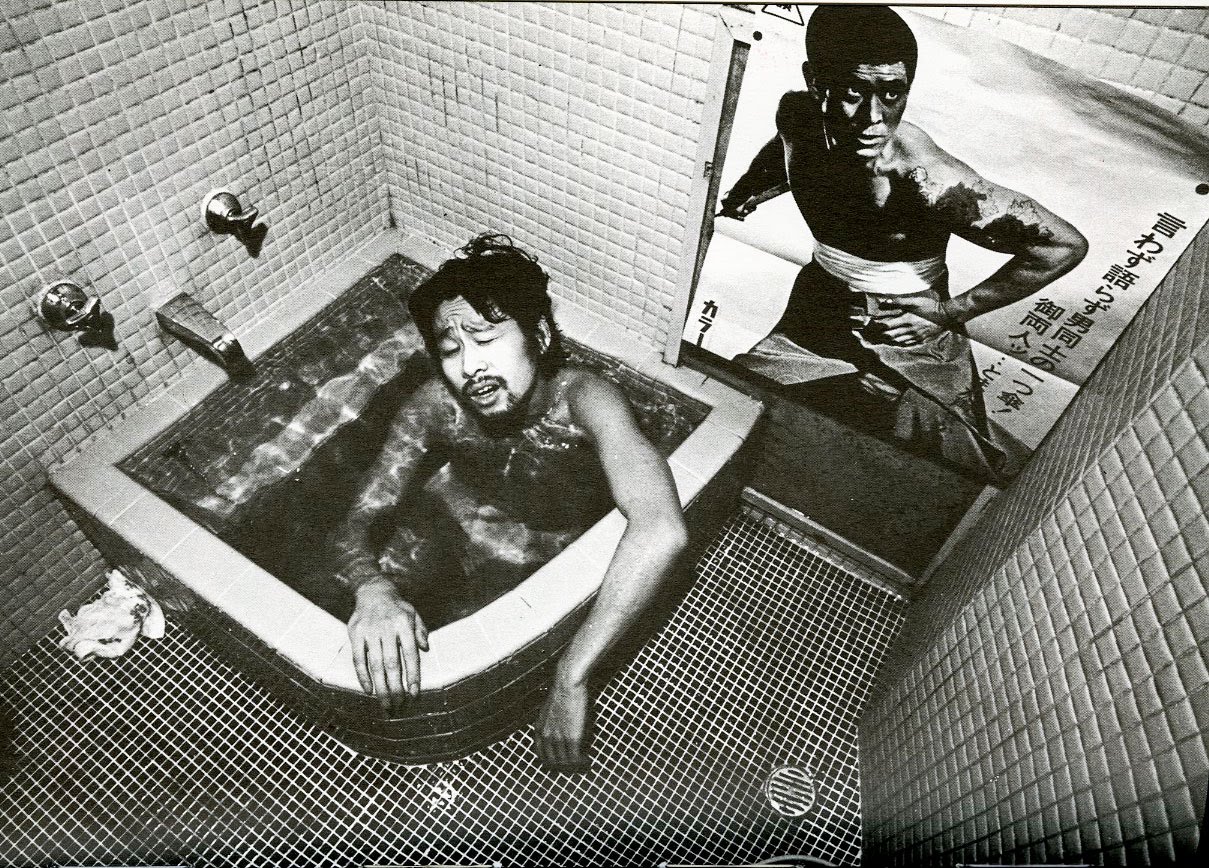
In the late 1960s he became interested in mysticism and psychedelia, deepened by travels in India. Because his work was so attuned to 1960s pop culture, he has often been (unfairly) described as the "Japanese Andy Warhol" or likened to psychedelic poster artist Peter Max, but Yokoo's complex and multi-layered imagery is intensely autobiographical and entirely original. By the late 60s he had already achieved international recognition for his work and was included in the 1968 "Word & Image" exhibition at the Museum of Modern Art in New York. Four years later MoMA mounted a solo exhibition of his graphic work organized by Mildred Constantine.[1]Shuji Terayama and his theater Tenjo Sajiki. He has also starred as a protagonist in Nagisa Oshima's film Diary of a Shinjuku Thief. Yokoo collaborated extensively with

In 1981 he unexpectedly "retired" from commercial work and took up painting. His career as a fine artist continues to this day with numerous exhibitions of his paintings every year, but alongside this he remains fully engaged and prolific as a graphic designer.

Found Here: http://en.wikipedia.org/wiki/Tadanori_Yokoo

Yokoo Tadanori began producing posters while attending high school in his hometown of Nishiwaki. Then, following stints at the Kobe Shimbun newspaper, the National Advertising Research Center, and after moving to Tokyo in 1960, the Nippon Design Center, Yokoo joined the Japan Advertising Artists Club at the tender age of 22.

In the mid-60s, through his relationships with Juro Kara and Shuji Terayama, Yokoo suddenly rose to prominence through works such as Koshi-maki Osen and La Marie Vison. At the same time, his illustrations for magazines such as Heibon Punch and Hanashi no Tokushu made him a darling of the media.

Yokoo's posters, which while reflecting post-war Japanese society, have been burned into our brains as unforgettable memories of the era. They are also notable for the fact that rather than following foreign trends, they display a unique sense of Japanese graphic design.

Yokoo's creative activities later expanding to include a wide range of fields such as painting and literature, but as he continued to produce posters throughout his career, the poster format functions as the core of his work as an artist.

In this exhibition, we present over 800 posters from the museum's collection along with invaluable documents from the artist's private collection in a full-scale introduction to Yokoo's overwhelming body of creative work that stretches over half a century.

Found Here: http://www.nmao.go.jp/english/b3_exhi_beginning_yokoo.html

(b Nishiwaki, Hyogo Prefect., 1936). Japanese stage designer, printmaker and painter. In 1960 he went to Tokyo and began his career as a stage designer. He was responsible for the design of such avant-garde drama as the Situation Theatre (Jokyo Gekijo) of Juro Kara (b 1940) and the Upper Gallery (Tenjo Sajiki) of Shuji Terayama (1935-83). He also produced prints and in 1967 exhibited works in the Word and Image exhibition at MOMA, New York. Although he used photographs as the basis of his designs, Yokoo's prints drew upon aspects of traditional Japanese woodcuts that coincided with the style of contemporary Pop art, using in particular flat areas of colour and overtly sexual subject-matter (e.g. X-sex IV, screenprint, 1968; priv. col., see Yokoo, 1990, p. 13). In addition to his activity as a commercial designer, from the late 1960s he became interested in mysticism and psychedelic art, influenced in particular by travels in India in the 1970s. He produced posters with eclectic imagery similar to that of contemporary psychedelic 'underground' magazines. In 1980 he unexpectedly took up painting, prompted by a large-scale travelling exhibition of Picasso's work that he saw in New York. He painted in an expressionistic figurative style works that appeared in stage productions for Yukio Mishima (1925-70) and in productions of operas by Richard Wagner.

Found Here: http://www.answers.com/topic/tadanori-yokoo

1936 Born in Hyogo Prefecture
1956 Nominated as member of Nissenbi(JAAC)Japan Advertising Artists Club
1960 Enters Nippon Design Center (NDC)
1964 Forms Studio "Ilfil"
1965 Participates in "Persona" exhibition (Matsuya Ginza)

Receives Mainichi Industrial Design Award
1966 Solo Exhibition (Nantenshi Gallery, Tokyo)
1968 Participates in "Word and Image" exhibition (MoMA, New York)
1969 Solo Exhibition (Tokyo Gallery)

Participates in "A Prospect of Modern Design in Japan" exhibition (The National Museum of Modern Art, Kyoto)

Awarded the Grand Prize for Prints at 6th Paris Youth Biennale

Participates in "18 Artists of Contemporary Prints" exhibition (Kyoto Municipal Museum of Art)

1970 Participates in Exhibition "Human Documents '70" (Tokyo Gallery)

Solo Exhibition (Matsuya Ginza, Kyoto, Kobe, Sapporo,Nagoya etc.)

Art-directs the Fiber Pavilion of Osaka Exposition
1971 "Chronicle of Art after World War II" Exhibition (Kanagawa Museum of Modern Art)

"The 10th Contemporary Art of Japan Exhibition" (Tokyo Metropolitan Art Museum, Kyoto Municipal Museum of Art)

"100 Artists in Art Today" (Hyogo Prefectural Museum of Modern Art)

1972 Solo Exhibition (MoMA, New York)

Receives the UNESCO Award of the 4th International Poster Biennale in Warsaw

Wins the Special prize in the 5th International Graphic design Biennale in Brno

Participates in "Print Art" Exhibition (Philadelphia Museum of Art)
1973 "Contemporary Art of Japan: A Panorama of Contemporary Japan Art in 20 years"(Tokyo Metropolitan Art Museum/Kyoto Municipal Museum of Art)

"Graphic Image '73" (Tokyo Central Museum / The National Museum of Modern Art, Kyoto)

Solo Exhibition (Museum fur Kunst und Gewerbe Hamburg)

Participates in Tour Exhibition in America "Contemporary Japan Prints"
(Museum of Fine Arts Boston/New York Culture Center)

Receives the Judge's Committee Prize of "Contemporary Japan Prints" (London ICA)

Wins the Grand Prize of Tokyo ADC
1974 Solo Exhibition (Stedelijk Museum, Amsterdam)

"The 11th Japan International Art Exhibition"(Tokyo Metropolitan Art Museum/Kyoto Municipal Museum of Art)

"Graphic design Image '74" (Tokyo Central Museum/The National Museum of Modern Art, Kyoto)

Receives the prize of Hyogo Prefectural Museum of Modern Art in the 9th International Print Art Biennale in Tokyo

Participates at the exhibition "Japan: Tradition and Contemporary" (Stadtmuseum, D us seldorf)

"Japanese Contemporary Prints" (Museo de Arte Moderno, Mexico)

Wins the Gold Prize of the 5th International Poster Biennale in Warsaw

Wins the Silver Prize of the 6th International Graphic Design Biennale in Brno
1975 Awarded the 20th Mainichi Design Award

"The 11th Contemporary Art in Japan Exhibition"(Tokyo Metropolitan Art Museum/Kyoto Municipal Museum of Art)

"Japanese Print Arts in 1975" Exhibition (Tochigi Prefectural Museum of Fine Arts)

"A Panorama of Contemporary Art in Japan" (Seibu Museum of Art, Tokyo)

"5 Japanese Graphic designers" (Musee cantonal des Beaux-Arts Lausanne/The National Museum of Contemporary Art, Oslo)
1976 Participates in Exhibition of "5 International Graphic Designers" at Venice Biennial
1977 "Contemporary Japanese Poster Exhibition" (Museu de Arte de Sao Paulo)

"The Past 10 years' Japanese Poster" (Stedelijk Museum Amsterdam)
1978 Wins the Merit Prize of The 7th International Poster Biennale in Warsaw

Awarded Kodansha Publishing Cultural Award for Binding
1979 Participates in '79 Art Festival in Tokyo (Tokyo Metropolitan Art Museum)

"Japanese Poster Exhibition" (Musee de la Publicite, Paris)

Wins 2000 Fmk Prize of the 3rd International Poster Biennial in Lahti
1980 Solo Exhibition (Okayama Art Museum)

Exhibits "Japan Style" (Victoria & Albert Museum, London)

"Japan-Poster" Exhibition (Museum of Modern Art, Vienna)
1981 Converted from a graphic designer to a painter

"World Contemporary Print in the 25 years"(Tokyo Metropolitan Art Museum / Tochigi Prefectural Museum of Fine Art/Hiroshima Prefectural Art Museum)

"A turning Point of Contemporary Art in 60's Japan"(The National Museum of Modern Art, Tokyo/The National Museum of Modern Art, Kyoto)
1982 Solo Exhibition (Museum fur Kunst und Gewerbe Hamburg)

Solo Exhibition (Nantenshi Gallery, Tokyo)
1983 Solo Exhibition ( Otani Memorial Art Museum,Nishinomiya city)

Solo Exhibition (Musee de la Publicite, Paris)

Participates in "A Tendency of Contemporary Art in Japan part 2: Departure to Diversity"(Tokyo Metropolitan Art Museum)
1984 Art-directs the stage decoration for Ballet "DIONYSOS", Belgique 20thCentury Ballet, produced by Maurice Bejart and Scara Theatre, MilanoSolo Exhibition (Otis Persons Gallery, Los Angeles)

"The 20th Century Posters: Avant-garde" at Walker Art Center, Minneapolis)

"The 2nd Toyama International Contemporary Art Exhibition" (The Museum of Modern Art, Toyama)

"A Panorama of Contemporary Art in Japan ム Graphic Art & Design"
(The Museum of Modern Art, Toyama)
1985 Invited works at The 13th Paris Biennale

Participates in The 18th Sao Paulo International Biennale

Solo Exhibition (Pallazzo Bianco, Genova)

Solo Exhibition (Farcone Theatre, Genova)

Solo Exhibition (Kunstlerhause Bethanien, Berlin)

"The 1st representational painting Biennale" (The Museum of Modern Art, Kanagawa)

"Contemporary Self-portrait" (The Museum of Modern Art, Saitama)

"Contemporary Art in 40 years" (Tokyo Metropolitan Art Museum)

"1985: Japanese Prints" (Tochigi Prefectural Museum of Fine Arts)
1986 Enters in "The 9th British International Print Biennale"

"Tokyo: Form and Spirit" (Walker Art Center, Minneapolis/The Museum of Contemporary Art, Los Angeles/IBM Gallery, New York/The San Francisco Museum of Modern Art)

"Japanese Avant-Garde 1910-1970" Exhibition (Centre Georges Pompidou, Paris)

"A Current of Contemporary Art in Japan: painting Part 1" (The Museum of Modern Art, Toyama)

Solo Exhibition (Roberta English Gallery, San Francisco)

Solo Exhibition (Israel Museum, Jerusalem)

Solo Exhibition (Roy Boyd Gallery, Los Angeles)

Exhibits "Art and Simplicity" (Setagaya Art Museum / Tochigi Prefectural Museum of Fine Art)
1987 Solo Exhibition (The Seibu Museum of Art, Tokyo)

Solo Exhibition (Carnegie Mellon University, Pittsburgh)

"Selection of the Frederick R. Weisman Foundation Collection of Art"(Pennsylvania, and several places in USA)

"Icons in Contemporary Art" (The Museum of Modern Art, Saitama)

Receives Hyogo Prefecture Cultural Award
1988 Solo Exhibition (Galerie Silvia Menzel, Berlin)

"The Modern Posters" (MoMA, New York)

Participates in "Art Kite" tour Japan, the U.S., and Europe in a traveling exhibition (The Miyagi Museum of Art)

"Human Image in Modern Art" (The National Museum of Modern Art, Tokyo)
1989 Receives Honorary Prize of The 4th ASIA Art Biennale, Bangladesh

"The 19th Contemporary Japan-Art" Exhibition (Tokyo Metropolitan Art Museum/Kyoto City Art Museum etc.)

"ARTIS '89 An international image for human and citizens' rights"(Centre Georges Pompidou, Paris)

"Contemporary Japanese Poster" Exhibition (MoMA, New York)
1990 Designs the plans of pavilion and garden for the Central American nation of Belize at Expo '90

The International Garden and Greenery Exposition held in Osaka

Participates in "Excellent Works in Modern Japanese Art: Zidai-wo-tsuranuku-bi" (Hyogo Prefectural Museum of Modern Art)

"Fantasy and Power: From Japanese Modern and Contemporary Art" (The Miyagi Museum of Art)
1991 Solo Exhibition (Sagacho Exhibit Space)

Exhibits in "Maniera-no-Kosaten: Contemporary Prints and Image Expression" (Machida City Museum of Graphic Arts)

"Beyond Japan: A Photo Theatre" (Barbican Art Gallery, London)

"Contemporary Japanese Graphic Design" (Design Museum, London)
1992 Exhibits in "Japan's Pop art 1960s" (Fukui Fine Arts Museum)

"Adam and Eve: 10th Anniversary Exhibition" (The Museum of Modern Art, Saitama)

"3 Japanese Poster Artists" (Tel Aviv Museum of Art)
1993 Participates in "45th Venice Biennale Trans-Actions" Venice, Italy

"International Poster Exhibition" (Tel Aviv Museum of Art)
1994 "Avant-garde Art in the Post War Japan"(Yokohama Museum of Art/ Guggenheim Museum SOHO, New York)

"Japanese Design" (Philadelphia Museum of Art)

"Art Today 1994" (Sezon Museum of Modern Art)

"The Pop Image Prints and Multiples" (Marlborough Gallery, New York)

Solo Exhibition (Contemporary Art Center, New Orleans)
1995 Receives the Mainichi Fine Art Award

Participates in "Sengo Bunka no Kiseki 1945-1995" (Japanese Culture:The Fifty Post-war Years)

(Meguro Museum of Art, Tokyo / Hiroshima City Museum of Contemporary Art / Hyogo Prefectural Museum of Modern Art / Fukuoka Prefectural Museum of Art)

The 1st Performance Poster International Triennial, Sophia (Bulgaria National Museum of Art)

Solo Exhibition (Tokyo Metropolitan Museum of Photography)

"Today's Art" (Louisiana Museum of Modern Art, Denmark)
1996 Solo Exhibition (Nantenshi Gallery, Tokyo)

"1960's Avant-garde Art in the Post War Japan" (Kurashiki City Art Museum)
1997 Solo Exhibition (Kirin Plaza, Osaka)

Solo Exhibition (Hyogo Prefectural Museum of Modern Art/ The Museum of Modern Art, Kanagawa)

Wins the Gold Prize of New York ADC Award

Publication. "The thing which cannot watch the thing which I see". A Chikuma library

Publication. "Return - Tadanori Yokoo Museum 1966-1997 to me." Hyogo Prefctural museum of art / Kanagawa prefectural Museum of Modern Art

Publication. "Asahi Museum - Tadanori Yokoo." Asahi Shimbun

Publication. "28 world graphic design - Tadanori Yokoo." King the graphic gallery

Publication. "Art of masterpiece response." I am pleased with a present of God. Kobunsha library

Publication. "I and intuition and an alien"(in the sky and the ground, similar figure - changes a title). Bunshun library

Publication. "Tokyo farewell look requiem." Asahi Shimbun

Publication. "A Yokoo's kissho-shofuku poster exhibition." (A fortune)Okanoyama Museum of art Nishiwaki
1998 Publication. "Tadanori Yokoo." In the days of a thing of red. (A fortune)Okanoyama Museum of art Nishiwaki

Publication. "A Yokoo's kissho-shofuku postcard book." Heibonsha Publishers Ltd.

Publication. "A collection of secret - Tadanori Yokoo talks to live now." Kobunsha library

Publication. "I lived in a flash in a friend". (Art is a love - change of the title). Kobunsha library

Publication. To "disturbance ! ". (Tadanori Yokoo autobiography - change of the title). Sentence spring library
1999

Exhibits in "Hyojo-han-hyojo: Prints in Japan 1945-1999" (Machida City Museum of Graphic Arts)


Solo Exhibition (Communications Museum, Tokyo)

"Ground Zero Japan" (Contemporary Art Gallery, Art Tower Mito)
2000 Solo Exhibition (Museum "Eki" Kyoto)

Elected to the Hall of the Hall of Fame, New York ADC
2001 Exhibits in "MoMA Highlights" (MoMA, New York)

"Century City ム Fine Arts and Culture of Contemporary City" (Tate Modern, London)

Solo Exhibition (The Museum of Modern Art, Toyama)

Solo Exhibition (Hara Museum of Contemporary Art, Tokyo)

Purple Ribbon Medal
2002 Professor for Postgraduate course of Tama Art University (March 2004)

Participates in "Pop! Pop!! Pop!!!" (The Museum of Modern Art, Ibaraki)

Solo Exhibition (Tokyo Metropolitan Museum of Contemporary Art / Hiroshima City Museum of Contemporary Art)

Awarded the ICOGRADA Special Prize of the 20th International Graphic Design Biennale in Brno
2003 Solo Exhibition (The National Museum of Modern Art, Kyoto)

Awarded the Slovakia Design Center Prize of the 5th 2003 Trnava Poster Exhibition (Slovakia)

Solo Exhibition (Fukuoka Art Museum)

Solo Exhibition (Entwistle Gallery, London)
2004 Directs the theatrical Arts and costume of public performance "King and Dragon : author Takeshi Umehara" in France

Wins the Silver prize of New York ADC

Exhibition "TAKARAZUKA: the Land of Dreams" (Suntory Museum, Tenpozan / Tokyo Opera City Art Gallery)

"Remaking modernism in Japan 1900-2000"(Museum of Contemporary Art,Tokyo / The University Art Museum-Tokyo National University of Fine Arts & Music)

Solo Exhibition (Miyazaki Prefectural Art Museum)

Solo Exhibition (SCAI the Bathhouse,Tokyo)

"Marcel Duchamp and the 20th Century Art" (The National Museum of Art,Osaka)

Received the Dark-blue Ribbon Medal from the Japanese Government

Directed the theatrical Art of "Takarazuka Dream Kingdam" by Takarazuka girls' operetta company

Produced the Rapping design for Electric Trains of JR Kakogawa-line

Received the International Jury Prize of The 3rd International Poster Biennial,Ningbo 2004 (China)
2005 Solo Exhibition (Contemporary Art Museum, Kumamoto)

Solo Exhibition (Ikeda Museum of 20th Century Art)

Solo Exhibition (Nantenshi Gallery, Tokyo)

Wins the Grand Prize of the 15th International Poster Biennial in Lahti

ISSEY MIYAKE PARIS COLLECTIONS 1977-1999: Invitations by Tadanori "Yokoo" (The Museum of Modern Art, Toyama)


The Last Exhibition of Parallelism in Art (Espace OHARA)
2006 Solo Exhibition (Fondation Cartier pour I' art contemporain ,Paris )

New Acquisition Contemporary Art and The Humor(Hiroshima City Museum of Contemporary Art)

"Dream, Rousseau whom Rousseau watched dream to watch" (Setagaya art museum)

Winning Japanese culture design grand prix
2007 "art / nonart / nonart 1950-1970" exhibition(J.Paulgetty Museum, Los Angeles)

War and an art exhibition(Kyoto formative arts University gallery Aube)

Art / nonart / nonart: Experiment in the public area in postwar Japan, 1950-1970(J.Paulgetty Museum, Los Angeles)

SEPTEMBER SHOW 2007(A Nishimura art gallery)

Imagery Play(PKM gallery Beijing)

MOT collection pop way 1960s - 2000s(Tokyo Museum of Contemporary Art)

Hyogo, person who has rendered distinguished services commendation.
Setagaya-ku, special culture service commendation.
2008 8 Solo exhibitions(Scai the bathhouse)

Solo exhibition(A Nishimura art gallery)

War and art. Fear and a vision of the beauty(Kyoto formative arts University gallery Aube)

An image of a human being exhibition of the 20th century.

A Tokushima prefectural Museum of Modern Art possession perfect gem exhibition(Gunma prefectural Tatebayashi art museum)

Japanese art: It is collected Hyogo from modern times to the present age(Oscar Niemmyer Museum)

The masked portrait(Marianne Boesky Gallery, N.Y.)

Asia and a European portrait exhibition(The National Museum of Art)

"Wonderland." A Japanese contemporary art exhibition(Opera gallery Hong-Kong)

An image to rebel against. The print media after the nonart and art. 1960 '-70'(Urawa Museum)

I publish novel "BURULAND" carried by literary arts magazine "Bungeishunju Ltd.".

Solo exhibition(Setagaya art museum)

Solo exhibition(Hyogo Tatsumi art building)

Solo exhibition(FRIEDMAN BENDA GALLERY)

Winning Kyoka Izumi literary

Found Here: http://www.tadanoriyokoo.com/prof/index.html