Harry Grant Dart was an American illustrator and comics artist active in the late 1800’s and early 1900s.
He worked for the Boston Herald and then the New York World, where he eventually held the position of Art Editor. He was one of the newspaper sketch artists who sketched important events for newspapers prior to the use of photographs (see my post on The Illustrators of La Domenica del Corriere). He also maintained an outside career as a magazine illustrator, working for titles like Life and Judge.
As a cartoonist Dart created a comic strip called The Explorigator, about a an airship staffed by a crew of adventurous kids. Meant to be a competitor for Winsor McCay’s spectacular strip Little Nemo in Slumberland, The Explorigator only ran for 14 weeks in 1908.
There aren’t a lot of resources on Dart that I could find, but there is a treasure of an archive of The Explorigator on the Barnicle Press site; sadly, not in color, but still a stunning example of this detailed, beautifully drawn and wildly imaginative strip.
The strip featured Dart’s penchant for drawing fantastic Victorian era aircraft, which also showed up in his other illustrations, like the image above (large version here on Flickr), done for a magazine called The All-Story.
I love the fact that he’s given us a liberated, fashionably attired Victorian era woman pilot, years before women could vote.
Harry Grant Dart (1869 – 1938) was an Americancartoonist and illustrator known for his futuristic and often aviation-oriented cartoons and comic strips.
His first jobs were brochures for the National Crayon Company and illustrations for the Boston Herald. His career took off when the New York World arranged to send him to Cuba. He became a sketch artist for important events, his sketches being published in the newspaper in the days before photographs were used. He rose to become the art editor for The World. It was at this time that he started perhaps his most famous comic strip, The Explorigator.[1]
Intended as a rival for Winsor McCay's Little Nemo, The Explorigator concerned the flight of the eponymous airship, headed by a crew of children ages 9–10: Admiral Fudge (who, interestingly, wore a swastika on his hat), Detective Rubbersole, Maurice Mizzentop, Nicholas Nohooks, Grenadier Shift, Teddy Typewriter, and Ah Fergetit.[2] The strip only ran for 14 weeks in 1908, yet its detailed drawings of airships and various other aircraft would later find some fame in the steampunk movement.[3]
Dart went on to become a very prolific cartoonist, continuing with Boys Will Be Boys in 1909 and Life and Judge in the 1920s. Although he is one of the more obscure cartoonists of his era, a few of his works survive in the Library of Congress.[4]
Writers, and often the public, like to romanticize the connection between madness and art. From the emotional anguish of van Gogh to the physical violence of Caravaggio, there is a notion of the artist going to the brink, and over, and returning with visions from the other side that would be inaccessible to the normal mind.
Whether this is true is a matter of debate, and mental illness is hardly romantic, though in the case of Victorian Painter Richard Dadd, his most memorable works of ramantic fantasy were produced after he was committed to “Bedlam” (Bethlem Hospital) because of violent insanity.
Dadd descended into a state we would now call paranoid schizophrenia during a trip to Egypt and the middle east. After his return, he murdered his father, who he evidently believed was possessed by the devil, and fled to Paris, where he was arrested for assaulting another traveler, who he also perceived as possessed. Evidently there was a genetic predisposition to mental illness in his family.
Dadd was a painter whose images of fairies and other subjects from folklore and fantasy are part of a larger stylistic branch of Victorian painting dealing with these subjects, sometimes simply called the “Fairy School”. His pre-commitment paintings of the subject were open and airy; those created afterwards, for which he is most noted, are quite different, large scale, flattened in perspective and richly (or obsessively) detailed.
Fairy Feller’s Master-Stroke, shown here, is his most recognized work. Dadd worked on it for nine years and still considered it unfinished. He finally did stop working on it, however, and then produced a copy in watercolor (the original is in oil) and wrote a strange “guidebook” for the painting in verse.
It’s difficult to get any feeling for this painting from the tiny image here. There is a large version here, another large one here and a larger one here, that is unfortunately a bit dark.
Low resolution web versions still don’t convey the detail in the image, though. If you are interested you really should look for a reproduction in print. The one I have is in Victorian Painting by Lionel Lambourne (an excellent book, BTW). There are also books devoted to Dadd’s work. The World of Richard Dadd by Michael Mott is inexpensive and serves as a nice introduction.
By all accounts, though, you really can’t grasp this painting, which is in the Tate Gallery in London, until you see it in person (I haven’t), because of the dramatically three-dimensional nature of the application of the paint.
Dadd did many other paintings during the time he spent in the hospitals, and his work has been influential on fantasy painters from his own time through the present.
Richard Dadd (1 August 1817 – 7 January 1886) was an English painter of the Victorian era, noted for his depictions of fairies and other supernatural subjects, Orientalist scenes, and enigmatic genre scenes, rendered with obsessively minuscule detail. Most of the works for which he is best known were created while he was incarcerated in a psychiatric hospital.
In July 1842, Sir Thomas Phillips, the former mayor of Newport, chose Dadd to accompany him as his draftsman on an expedition through Europe to Greece, Turkey, Palestine and finally Egypt. In November of that year they spent a gruelling two weeks in Palestine, passing from Jerusalem to Jordan and returning across the Engaddi wilderness. Toward the end of December, while travelling up the Nile by boat, Dadd underwent a dramatic personality change, becoming delusional and increasingly violent, and believing himself to be under the influence of the Egyptian god Osiris. His condition was initially thought to be sunstroke.[2]
On his return in the spring of 1843, he was diagnosed to be of unsound mind and was taken by his family to recuperate in the countryside village of Cobham, Kent. In August of that year, having become convinced that his father was the Devil in disguise, Dadd killed him with a knife and fled for France.[3] En route to Paris Dadd attempted to kill another tourist with a razor, but was overpowered and was arrested by the police. Dadd confessed to the killing of his father and was returned to England, where he was committed to the criminal department of BethlemBroadmoor Hospital, Dadd was cared for (and encouraged to continue painting) by the likes of Drs William Wood and Sir W. Charles Hood, in an enlightened manner. psychiatric hospital (also known as Bedlam). Here and subsequently at the newly created
Dadd probably suffered from a form of paranoid schizophrenia.[4] He appears to have been genetically predisposed to mental illness; two of his siblings were similarly afflicted, while a third had "a private attendant" for unknown reasons.[2]
In the hospital he was allowed to continue to paint and it was here that many of his masterpieces were created, including his most celebrated painting, The Fairy Feller's Master-Stroke, which he worked on between 1855 and 1864. Also dating from the 1850s are the thirty-three watercolour drawings titled Sketches to Illustrate the Passions, which include Grief or Sorrow, Love, and Jealousy, as well as Agony-Raving Madness and Murder. Like most of his works these are executed on a small scale and feature protagonists whose eyes are fixed in a peculiar, unfocused stare. Dadd also produced many shipping scenes and landscapes during his incarceration, such as the ethereal 1861 watercolour Port Stragglin. These are executed with a miniaturist's eye for detail which belie the fact that they are products of imagination and memory.[5]
After 20 years at Bethlem, Dadd was moved to the criminal lunatic asylum at Broadmoor, outside London. Here he remained, painting constantly and receiving infrequent visitors until 7 January 1886, when he died, "from an extensive disease of the lungs."[6]
Richard Dadd was an English faery painter and illustrator. Born in Chatham, Kent, Dadd began drawing at the age of 14 and entered the Royal Academy Schools in 1837. His promising career was interrupted by a sudden mental breakdown during a trip to the Holy Land (1842-3).
Dadd returned to London and murdered his father. Committed as insane in 1844, Dadd spent the rest of his life in care. In London's Bethlem Hospital he painted his meticulously worked oils Oberon and Titania (1854-8; private collection) and the The Faery Feller's Master Stroke (1855-64; Tate Gallery, London).
In 1864 he was moved to Broadmoor; he continued to paint well on into the 1880s.
The public has always been fascinated by the concept of the mad artist, a creative genius in an alien world, a prey to hallucinations which his works reveal to us as visions from another world. The tragic Richard Dadd (1817-86) was just such a figure. As a young man he was a member of 'The Clique', an informal group of artists who came together in the year of Queen Victoria's accession, 1837. Other members included William Powell Frith, Henry O'Neill, Augustus Leopald Egg, John Phillip (1817-67), Edward Matthew Ward, Alfred Elmore and Thomas Joy (1812-66). It was essentially a sketching society for students, for Dadd, Phillip and Frith were all pupils of the Royal Academy Schools.
The young artists met weekly at Dadd's rooms, where they spent an hour or two sketching subjects drawn in the main from Shakespeare or Byron, after which one of the guests would choose the best drawing. Dadd, generally acknowledged to be the finest draughtsman, often undertook character portraits of members of the group. The evenings ended with a light supper of bread, cheese and beer. At one of their meetings, they mapped out their futures, as young men will: 'Frith said he intended to paint pictures of ordinary life, such as would take with the public. O'Neil determined on painting incidents of striking character, appealing to the feelings, and Phillip desired to illustrate incidents in the lives of famous persons. Dadd proposed to devote himself to works of the imagination.' In this ambition he was to succeed beyond his wildest dreams.
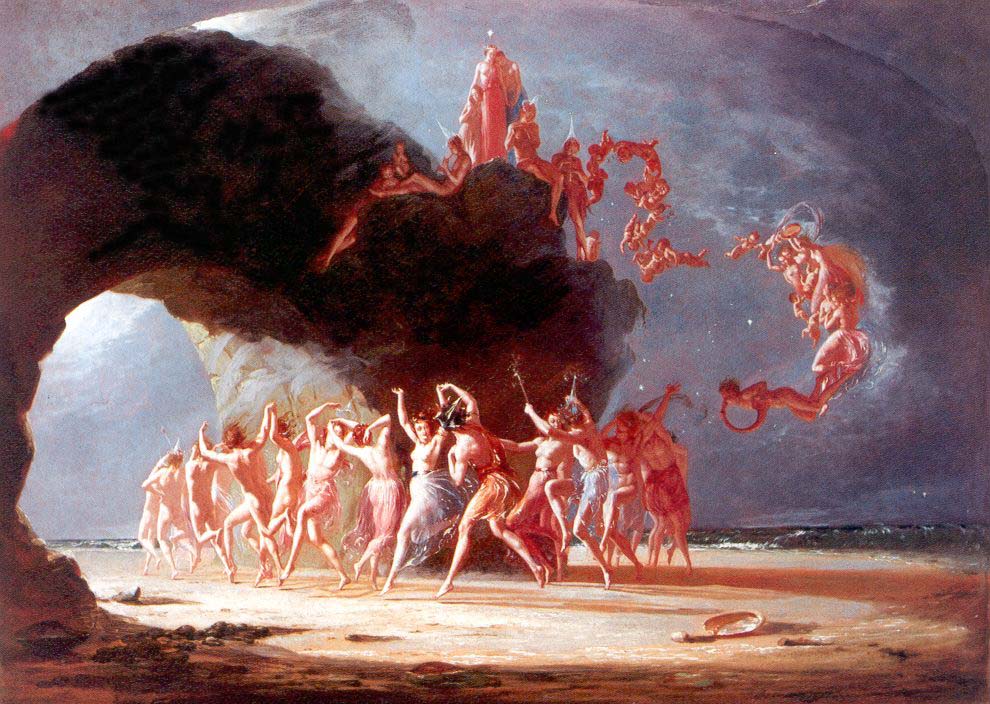
Dadd was born in 1817 at Chatham in Kent where his father was a chemist. When in 1837 he entered the Royal Academy Schools, with a recommendation from Clarkson Stansfield, his father moved to London to provide him with a home. Dadd exhibited portraits and landscapes at the Academy and elsewhere until 1841, when he gained a major commission to paint a large number of panels for a nobleman's house in Grosvenor Square, some of the subjects being drawn from Byron's Manfred. The only known account of them describes how 'the Alpine mist or smoke about Manfred's head [was] ... composed of minute figures of men and women, explained by Dadd to be ideas formed and unformed, as their outlines were distinct or indistinct.' At the summer exhibitions of the Royal Academy that year Dadd exhibited one of his first important fairy paintings, Come unto these Yellow Sands, with the lines from Ariel's song in The Tempest:
Come unto these yellow sands And then take hands ... Foot is featly here and there, And, sweet sprites, the burden bear.
Dadd's paintings of fairies before the onset of his insanity have a lightness and ethereal sense of freedom, quite different from the intensely detailed and elaborately wrought delicacy of the later paintings.
In July 1842, recommended by David Roberts, Dadd accompanied Sir Thomas Phillips on an expedition to Egypt and Asia Minor. He painted many vivid watercolours of picturesque views but gradually, after a bad sun-stroke at Thebes, became more and more disturbed. It now seems likely, however, that this was only a contributory factor to his condition, which we would today describe as paranoid schizophrenia. On the return jouney the party visited Rome, where Dadd felt a strong inclination to attack the Pope 'in a public place', but 'overcame the desire' as the Pontiff was so well protected. In Paris, rather than see a doctor he fled back to London, where he arrived in April 1843 in time to submit a cartoon for Westminister of St. George after the death of the dragon which, according to Frith, had an inordinately long tail. Stress and turmoil continued to assail him, and he became convinced that he was constantly being watched, a classic sympton of a persecution complex. His dementia grew until at the end of August he purchased a newcut-throat razor, which he used to kill his devoted father in Cobham Park.
Dadd fled to France but was detained in Paris after trying to kill a fellow passenger on a coach, who was, he said, possessed by a devil. He remained in France for ten months before being returned to London, where he admitted his crime, claiming to be descended from the Egyptian god Osiris who had ordered him to kill his father who was possessed by the devil. On 22 August 1844 he was admitted to Bethlem Hospital, aged 27. Amazingly, most of his best work would be painted in the next forty-two years, at first at Bethlem and later at Broadmoor. From an early date he seems to have been given access to both watercolours and oils. He used the watercolours to paint a long series of works dealing with various human passions, and the oils to create his two masterpieces, Contradiction: Oberon and Titinia, the labour of four years from 1854 to 1858, and The Fairy Feller's Master-Stroke, on which he worked from 1857 to 1864.
In The Fairy Feller our first visual impression of the work is akin to the sense of wonder when we lift a flagstone and stare down at the myriad activities of the insect world concealed underneath. Long grasses slant from side to side across the picture's surface, carpeted with hare bells, convolvulus, hazel-nuts and daisies, and a butterfly rests on a leaf. The fairy feller himself stands at the bottom right of the picture, with his primitive stone axe poised to split a nut to form a new chariot for Queen Mab. The complex cast of dwarves, fairies and figures, drawn from Dadd's watercolour works called The Passions, all stand motionless awaiting the fall of the axe, a complete world frozen in suspense.
Dadd wrote a long commentary to accompany the painting, entitled An Elimination and dated January 1865, in which he asks us to forgive his fancies: 'You can afford to let this go for naught or nothing it explains. And nothing from nothing nothing gains.' Devoid of female companionship, he describes the loneliness of his own lot 'shut out from nature's game, banished from nature's book of life'. He died in January 1886.
Raymond Georges Yves Tanguy (January 5, 1900 – January 15, 1955), known as Yves Tanguy, was a surrealist painter.
Tanguy was born in Paris, France, the son of a retired navy captain. His parents were both of Breton origin. After his father's death in 1908, his mother moved back to her native Locronan, Finistère, and he ended up spending much of his youth living with various relatives.
In 1918, Yves Tanguy briefly joined the merchant navy before being drafted into the Army, where he befriended Jacques Prévert. At the end of his military service in 1922, he returned to Paris, where he worked various odd jobs. By chance, he stumbled upon a painting by Giorgio de Chirico and was so deeply impressed he resolved to become a painter himself in spite of his complete lack of formal training.
Tanguy had a habit of being completely absorbed by the current painting he was working on. This way of creating artwork may have been due to his very small studio which only had enough room for one wet piece.
Through his friend Jacques Prévert, in around 1924 Tanguy was introduced into the circle of surrealist artists around André Breton. Tanguy quickly began to develop his own unique painting style, giving his first solo exhibition in Paris in 1927, and marrying his first wife later that same year. During this busy time of his life, André Breton gave Tanguy a contract to paint 12 pieces a year. With his fixed income, he painted less and only ended up creating eight works of art for Breton.
Throughout the 1930s, Tanguy adopted the bohemian lifestyle of the struggling artist with gusto, leading eventually to the failure of his first marriage. In 1938, after seeing the work of fellow artist Kay Sage, Tanguy began a relationship with her that would eventually lead to his second marriage.
With the outbreak of World War II, Sage moved back to her native New York, and Tanguy, judged unfit for military service, followed her. He would spend the rest of his life in the United States. Sage and Tanguy were married in Reno, Nevada on August 17, 1940. Toward the end of the war, the couple moved to Woodbury, Connecticut, converting an old farmhouse into an artists' studio. They spent the rest of their lives there. In 1948, he became a naturalized citizen of the United States.
In January 1955, Tanguy suffered a fatal stroke at Woodbury. His body was cremated and his ashes preserved until Sage's death in 1963. Later, his ashes were scattered by his friend Pierre Matisse on the beach at Douarnenez in his beloved Brittany, together with those of his wife.[1]
Yves Tanguy's paintings have a unique, immediately recognizable style of nonrepresentational surrealism. They show vast, abstract landscapes, mostly in a tightly limited palette of colors, only occasionally showing flashes of contrasting color accents. Typically, these alien landscapes are populated with various abstract shapes, sometimes angular and sharp as shards of glass, sometimes with an intriguingly organic look to them, like giant amoebae suddenly turned to stone.
This account was written in 1969 for publication in Marihuana Reconsidered (1971). Sagan was in his mid-thirties at that time. He continued to use cannabis for the rest of his life.
It all began about ten years ago. I had reached a considerably more relaxed period in my life - a time when I had come to feel that there was more to living than science, a time of awakening of my social consciousness and amiability, a time when I was open to new experiences. I had become friendly with a group of people who occasionally smoked cannabis, irregularly, but with evident pleasure. Initially I was unwilling to partake, but the apparent euphoria that cannabis produced and the fact that there was no physiological addiction to the plant eventually persuaded me to try. My initial experiences were entirely disappointing; there was no effect at all, and I began to entertain a variety of hypotheses about cannabis being a placebo which worked by expectation and hyperventilation rather than by chemistry. After about five or six unsuccessful attempts, however, it happened. I was lying on my back in a friend's living room idly examining the pattern of shadows on the ceiling cast by a potted plant (not cannabis!). I suddenly realized that I was examining an intricately detailed miniature Volkswagen, distinctly outlined by the shadows. I was very skeptical at this perception, and tried to find inconsistencies between Volkswagens and what I viewed on the ceiling. But it was all there, down to hubcaps, license plate, chrome, and even the small handle used for opening the trunk. When I closed my eyes, I was stunned to find that there was a movie going on the inside of my eyelids. Flash . . . a simple country scene with red farmhouse, a blue sky, white clouds, yellow path meandering over green hills to the horizon. . . Flash . . . same scene, orange house, brown sky, red clouds, yellow path, violet fields . . . Flash . . . Flash . . . Flash. The flashes came about once a heartbeat. Each flash brought the same simple scene into view, but each time with a different set of colors . . . exquisitely deep hues, and astonishingly harmonious in their juxtaposition. Since then I have smoked occasionally and enjoyed it thoroughly. It amplifies torpid sensibilities and produces what to me are even more interesting effects, as I will explain shortly.
I can remember another early visual experience with cannabis, in which I viewed a candle flame and discovered in the heart of the flame, standing with magnificent indifference, the black-hatted and -cloaked Spanish gentleman who appears on the label of the Sandeman sherry bottle. Looking at fires when high, by the way, especially through one of those prism kaleidoscopes which image their surroundings, is an extraordinarily moving and beautiful experience.
I want to explain that at no time did I think these things 'really' were out there. I knew there was no Volkswagen on the ceiling and there was no Sandeman salamander man in the flame. I don't feel any contradiction in these experiences. There's a part of me making, creating the perceptions which in everyday life would be bizarre; there's another part of me which is a kind of observer. About half of the pleasure comes from the observer-part appreciating the work of the creator-part. I smile, or sometimes even laugh out loud at the pictures on the insides of my eyelids. In this sense, I suppose cannabis is psychotomimetic, but I find none of the panic or terror that accompanies some psychoses. Possibly this is because I know it's my own trip, and that I can come down rapidly any time I want to.
While my early perceptions were all visual, and curiously lacking in images of human beings, both of these items have changed over the intervening years. I find that today a single joint is enough to get me high. I test whether I'm high by closing my eyes and looking for the flashes. They come long before there are any alterations in my visual or other perceptions. I would guess this is a signal-to-noise problem, the visual noise level being very low with my eyes closed. Another interesting information-theoretical aspects is the prevalence - at least in my flashed images - of cartoons: just the outlines of figures, caricatures, not photographs. I think this is simply a matter of information compression; it would be impossible to grasp the total content of an image with the information content of an ordinary photograph, say 108 bits, in the fraction of a second which a flash occupies. And the flash experience is designed, if I may use that word, for instant appreciation. The artist and viewer are one. This is not to say that the images are not marvelously detailed and complex. I recently had an image in which two people were talking, and the words they were saying would form and disappear in yellow above their heads, at about a sentence per heartbeat. In this way it was possible to follow the conversation. At the same time an occasional word would appear in red letters among the yellows above their heads, perfectly in context with the conversation; but if one remembered these red words, they would enunciate a quite different set of statements, penetratingly critical of the conversation. The entire image set which I've outlined here, with I would say at least 100 yellow words and something like 10 red words, occurred in something under a minute.
The cannabis experience has greatly improved my appreciation for art, a subject which I had never much appreciated before. The understanding of the intent of the artist which I can achieve when high sometimes carries over to when I'm down. This is one of many human frontiers which cannabis has helped me traverse. There also have been some art-related insights - I don't know whether they are true or false, but they were fun to formulate. For example, I have spent some time high looking at the work of the Belgian surrealist Yves Tanguey (see above). Some years later, I emerged from a long swim in the Caribbean and sank exhausted onto a beach formed from the erosion of a nearby coral reef. In idly examining the arcuate pastel-colored coral fragments which made up the beach, I saw before me a vast Tanguey painting. Perhaps Tanguey visited such a beach in his childhood.
A very similar improvement in my appreciation of music has occurred with cannabis. For the first time I have been able to hear the separate parts of a three-part harmony and the richness of the counterpoint. I have since discovered that professional musicians can quite easily keep many separate parts going simultaneously in their heads, but this was the first time for me. Again, the learning experience when high has at least to some extent carried over when I'm down. The enjoyment of food is amplified; tastes and aromas emerge that for some reason we ordinarily seem to be too busy to notice. I am able to give my full attention to the sensation. A potato will have a texture, a body, and taste like that of other potatoes, but much more so. Cannabis also enhances the enjoyment of sex - on the one hand it gives an exquisite sensitivity, but on the other hand it postpones orgasm: in part by distracting me with the profusion of image passing before my eyes. The actual duration of orgasm seems to lengthen greatly, but this may be the usual experience of time expansion which comes with cannabis smoking.
I do not consider myself a religious person in the usual sense, but there is a religious aspect to some highs. The heightened sensitivity in all areas gives me a feeling of communion with my surroundings, both animate and inanimate. Sometimes a kind of existential perception of the absurd comes over me and I see with awful certainty the hypocrisies and posturing of myself and my fellow men. And at other times, there is a different sense of the absurd, a playful and whimsical awareness. Both of these senses of the absurd can be communicated, and some of the most rewarding highs I've had have been in sharing talk and perceptions and humor. Cannabis brings us an awareness that we spend a lifetime being trained to overlook and forget and put out of our minds. A sense of what the world is really like can be maddening; cannabis has brought me some feelings for what it is like to be crazy, and how we use that word 'crazy' to avoid thinking about things that are too painful for us. In the Soviet Union political dissidents are routinely placed in insane asylums. The same kind of thing, a little more subtle perhaps, occurs here: 'did you hear what Lenny Bruce said yesterday? He must be crazy.' When high on cannabis I discovered that there's somebody inside in those people we call mad.
When I'm high I can penetrate into the past, recall childhood memories, friends, relatives, playthings, streets, smells, sounds, and tastes from a vanished era. I can reconstruct the actual occurrences in childhood events only half understood at the time. Many but not all my cannabis trips have somewhere in them a symbolism significant to me which I won't attempt to describe here, a kind of mandala embossed on the high. Free-associating to this mandala, both visually and as plays on words, has produced a very rich array of insights.
There is a myth about such highs: the user has an illusion of great insight, but it does not survive scrutiny in the morning. I am convinced that this is an error, and that the devastating insights achieved when high are real insights; the main problem is putting these insights in a form acceptable to the quite different self that we are when we're down the next day. Some of the hardest work I've ever done has been to put such insights down on tape or in writing. The problem is that ten even more interesting ideas or images have to be lost in the effort of recording one. It is easy to understand why someone might think it's a waste of effort going to all that trouble to set the thought down, a kind of intrusion of the Protestant Ethic. But since I live almost all my life down I've made the effort - successfully, I think. Incidentally, I find that reasonably good insights can be remembered the next day, but only if some effort has been made to set them down another way. If I write the insight down or tell it to someone, then I can remember it with no assistance the following morning; but if I merely say to myself that I must make an effort to remember, I never do.
I find that most of the insights I achieve when high are into social issues, an area of creative scholarship very different from the one I am generally known for. I can remember one occasion, taking a shower with my wife while high, in which I had an idea on the origins and invalidities of racism in terms of gaussian distribution curves. It was a point obvious in a way, but rarely talked about. I drew the curves in soap on the shower wall, and went to write the idea down. One idea led to another, and at the end of about an hour of extremely hard work I found I had written eleven short essays on a wide range of social, political, philosophical, and human biological topics. Because of problems of space, I can't go into the details of these essays, but from all external signs, such as public reactions and expert commentary, they seem to contain valid insights. I have used them in university commencement addresses, public lectures, and in my books.
But let me try to at least give the flavor of such an insight and its accompaniments. One night, high on cannabis, I was delving into my childhood, a little self-analysis, and making what seemed to me to be very good progress. I then paused and thought how extraordinary it was that Sigmund Freud, with no assistance from drugs, had been able to achieve his own remarkable self-analysis. But then it hit me like a thunderclap that this was wrong, that Freud had spent the decade before his self-analysis as an experimenter with and a proselytizer for cocaine; and it seemed to me very apparent that the genuine psychological insights that Freud brought to the world were at least in part derived from his drug experience. I have no idea whether this is in fact true, or whether the historians of Freud would agree with this interpretation, or even if such an idea has been published in the past, but it is an interesting hypothesis and one which passes first scrutiny in the world of the downs.
I can remember the night that I suddenly realized what it was like to be crazy, or nights when my feelings and perceptions were of a religious nature. I had a very accurate sense that these feelings and perceptions, written down casually, would not stand the usual critical scrutiny that is my stock in trade as a scientist. If I find in the morning a message from myself the night before informing me that there is a world around us which we barely sense, or that we can become one with the universe, or even that certain politicians are desperately frightened men, I may tend to disbelieve; but when I'm high I know about this disbelief. And so I have a tape in which I exhort myself to take such remarks seriously. I say 'Listen closely, you sonofabitch of the morning! This stuff is real!' I try to show that my mind is working clearly; I recall the name of a high school acquaintance I have not thought of in thirty years; I describe the color, typography, and format of a book in another room and these memories do pass critical scrutiny in the morning. I am convinced that there are genuine and valid levels of perception available with cannabis (and probably with other drugs) which are, through the defects of our society and our educational system, unavailable to us without such drugs. Such a remark applies not only to self-awareness and to intellectual pursuits, but also to perceptions of real people, a vastly enhanced sensitivity to facial expression, intonations, and choice of words which sometimes yields a rapport so close it's as if two people are reading each other's minds.
Cannabis enables nonmusicians to know a little about what it is like to be a musician, and nonartists to grasp the joys of art. But I am neither an artist nor a musician. What about my own scientific work? While I find a curious disinclination to think of my professional concerns when high - the attractive intellectual adventures always seem to be in every other area - I have made a conscious effort to think of a few particularly difficult current problems in my field when high. It works, at least to a degree. I find I can bring to bear, for example, a range of relevant experimental facts which appear to be mutually inconsistent. So far, so good. At least the recall works. Then in trying to conceive of a way of reconciling the disparate facts, I was able to come up with a very bizarre possibility, one that I'm sure I would never have thought of down. I've written a paper which mentions this idea in passing. I think it's very unlikely to be true, but it has consequences which are experimentally testable, which is the hallmark of an acceptable theory.
I have mentioned that in the cannabis experience there is a part of your mind that remains a dispassionate observer, who is able to take you down in a hurry if need be. I have on a few occasions been forced to drive in heavy traffic when high. I've negotiated it with no difficult at all, though I did have some thoughts about the marvelous cherry-red color of traffic lights. I find that after the drive I'm not high at all. There are no flashes on the insides of my eyelids. If you're high and your child is calling, you can respond about as capably as you usually do. I don't advocate driving when high on cannabis, but I can tell you from personal experience that it certainly can be done. My high is always reflective, peaceable, intellectually exciting, and sociable, unlike most alcohol highs, and there is never a hangover. Through the years I find that slightly smaller amounts of cannabis suffice to produce the same degree of high, and in one movie theater recently I found I could get high just by inhaling the cannabis smoke which permeated the theater.
There is a very nice self-titering aspect to cannabis. Each puff is a very small dose; the time lag between inhaling a puff and sensing its effect is small; and there is no desire for more after the high is there. I think the ratio, R, of the time to sense the dose taken to the time required to take an excessive dose is an important quantity. R is very large for LSD (which I've never taken) and reasonably short for cannabis. Small values of R should be one measure of the safety of psychedelic drugs. When cannabis is legalized, I hope to see this ratio as one of he parameters printed on the pack. I hope that time isn't too distant; the illegality of cannabis is outrageous, an impediment to full utilization of a drug which helps produce the serenity and insight, sensitivity and fellowship so desperately needed in this increasingly mad and dangerous world.
century B.C.E. – that was found in excavations outside Jerusalem’s Old City walls contains the oldest written document ever found in Jerusalem, say researchers at the Hebrew University of Jerusalem. The find, believed to be part of a tablet from a royal archives, further testifies to the importance of Jerusalem as a major city in the Late Bronze Age, long before its conquest by King David, they say.
The clay fragment was uncovered recently during sifting of fill excavated from beneath a 10th century B.C.E. tower dating from the period of King Solomon in the Ophel area, located between the southern wall of the Old City of Jerusalem and the City of David to its south. Details of the discovery appear in the current issue of the Israel Exploration Journal.
Excavations in the Ophel have been conducted by Dr. Eilat Mazar of the Hebrew University Institute of Archaeology. Funding for the project has been provided by Daniel Mintz and Meredith Berkman of New York, who also have provided funds for completion of the excavations and opening of the site to the public by the Israel Antiquities Authority, in cooperation with the Israel Nature and Parks Authority and the Company for the Development of East Jerusalem. The sifting work was led by Dr.Gabriel Barkay and Zachi Zweig at the Emek Zurim wet-sieving facility site.
The fragment that has been found is 2x2.8 centimeters in size and one centimeter thick. Dated to the 14th century B.C.E., it appears to have been part of a tablet and contains cuneiform symbols in ancient Akkadian (the lingua franca of that era).
The words the symbols form are not significant in themselves, but what is significant is that the script is of a very high level, testifying to the fact that it was written by a highly skilled scribe that in all likelihood prepared tablets for the royal household of the time, said Prof. Wayne Horowitz , a scholar of Assyriology at the Hebrew University Institute of Archaeology. Horowitz deciphered the script along with his former graduate student Dr. Takayoshi Oshima, now of the University of Leipzig, Germany.
Tablets with diplomatic messages were routinely exchanged between kings in the ancient Near East, Horowitz said, and there is a great likelihood, because of its fine script and the fact it was discovered adjacent to in the acropolis area of the ancient city, that the fragment was part of such a “royal missive.” Horowitz has interpreted the symbols on the fragment to include the words “you,” “you were,” “later,” “to do” and “them.”
The most ancient known written record previously found in Jerusalem was the tablet found in the Shiloah water tunnel in the City of David area during the 8th century B.C.E. reign of King Hezekiah. That tablet, celebrating the completion of the tunnel, is in a museum in Istanbul. This latest find predates the Hezekiah tablet by about 600 years.
The fragment found at the Ophel is believed to be contemporary with the some 380 tablets discovered in the 19th century at Amarna in Egypt in the archives of Pharaoh Amenhotep IV (Akhenaten), who lived in the 14th century B.C.E. The archives include tablets sent to Akhenaten by the kings who were subservient to him in Canaan and Syria and include details about the complex relationships between them, covering many facets of governance and society. Among these tablets are six that are addressed from Abdi-Heba, the Canaanite ruler of Jerusalem. The tablet fragment in Jerusalem is most likely part of a message that would have been sent from the king of Jerusalem, possibly Abdi-Heba, back to Egypt, said Mazar.
Examination of the material of the fragment by Prof. Yuval Goren of Tel Aviv University, shows that it is from the soil of the Jerusalem area and not similar to materials from other areas, further testifying to the likelihood that it was part of a tablet from a royal archive in Jerusalem containing copies of tablets sent by the king of Jerusalem to Pharaoh Akhenaten in Egypt.
Mazar says this new discovery, providing solid evidence of the importance of Jerusalem during the Late Bronze Age (the second half of the second century B.C.E.), acts as a counterpoint to some who have used the lack of substantial archeological findings from that period until now to argue that Jerusalem was not a major center during that period. It also lends weight to the importance that accrued to the city in later times, leading up to its conquest by King David in the 10th century B.C.E., she said
An unidentified flying object (UFO) disrupted air traffic over Zhejiang's provincial capital Hangzhou late on Wednesday, the municipal government said on Thursday.
Xiaoshan Airport was closed after the UFO was detected at around 9 pm, and some flights were rerouted to airports in the cities of Ningbo and Wuxi , said an airport spokesman, who declined to be named.
The airport had resumed operations, and more details will be released after an investigation, he said.
A source with knowledge of the matter, however, told China Daily on Thursday that authorities had learned what the UFO was after an investigation.
But it was not the proper time to publicly disclose the information because there was a military connection, he said, adding that an official explanation is expected to be given on Friday.
Inbound flights were diverted to the nearby airports in Zhejiang province's Ningbo and Jiangsu province's Wuxi. Outbound flights were delayed for three to four hours.
A staff member at the airport's information desk said the airport had "no idea" how many flights were affected by the closure.
At around 11 pm on Wednesday, a netizen wrote three entries announcing the airport's closure in
his microblog at Sina.com, but they were all soon deleted.
He posted an apology at midnight, saying the news had not been confirmed and asking those who had republished his earlier entries to delete them.
A UFO seen hovering over East China's Zhejiang Province on Wednesday evening caused massive flight delays at Xiaoshan International Airport after air traffic controllers shut down the airport for one hour, the China News Service reported Thursday.
Control tower officers detected the unidentified flying object with long-range visual instruments. They immediately ordered several incoming flights to land at airports in neighboring Ningbo and Wuxi, delaying passengers for nearly four hours, the report said.
"The UFO could not be seen with the naked eye. It had to be spotted with observation devices," an unidentified airport staff member told the Xinhua News Agency.
However, some local residents swore they saw the UFO with their own eyes.
"I saw an extremely bright spot very high up in the sky around 8 pm. The yellow spot immediately slid through the sky and disappeared within a second," Jia Xiaoying, 27, a Hangzhou resident who is also an E.T. fan, told the Global Times Thursday.
Residents living near the Xiaoshan airport and the city's Fuxing road also reported visual sightings of the UFO, describing a few sparkling flashes of light that streaked through the sky and disappeared within minutes, the Zhejiang-based Today Morning Express reported Thursday.
Air traffic control authorities used radar to try to monitor the position of the UFO Thursday but no data on its latitude and longitude was made available to the public.
An unidentified source with a government agency told China News Service that it could have been a private airplane.
The Xiaoshan airport resumed normal operations Thursday with only a few flights delayed.
Airport police and other agencies were investigating the incident, but no further information was released late Thursday.
Hangzhou is one of several Chinese cities where UFOs have been spotted since last week.
A UFO trailed by a fan-shaped white light appeared last Wednesday in Urumqi, Northwest China's Xinjiang Uyghur Autonomous Region. The unidentified flying object was later identified as debris from an intercontinental missile launched by the US, according to Song Huagang, secretary general of the Xinjiang Astronomy Society, speaking earlier to the Xinjiang Metropolis Daily.
Researcher cracks 'secret' code in U.S. Cyber Command logo MD5 cryptographic hash translates into cyber defense command's mission statement
A security researcher said on Thursday he was the first to crack the code embedded in the seal of the U.S. Cyber Command (Cybercom), the group responsible for protecting the country's military networks from attack.
Sean-Paul Correll, a threat researcher with antivirus vendor Panda Security, said that the characters visible in a gold ring on Cybercom's official seal represent the MD5 hash of the group's mission statement. MD5 is a 128-bit cryptographic hash most often used to verify file integrity.
A representative of Cybercom confirmed that Correll had it right. " Mr. Correll is correct...it's a MD5 hash," said Lt. Commander Steve Curry of the U.S. Navy, in an e-mail.
"It wasn't very difficult," said Correll, adding that thanks to the clue on Wired.com's Danger Room blog, it took him just a few minutes to figure out that the characters -- 9ec4c12949a4f31474f299058ce2b22a -- were the hash value for Cybercom's mission statement.
"I knew right away it was an MD5 hash, and I was fairly confident that it wasn't a specific file," said Correll, adding that security professionals will often use an MD5 hash as reminders, or to verify that a file's contents after downloading match the original edition.
Correll said he figured out the mystery shortly after 10 a.m. PT Wednesday, within an hour of Wired.com publishing its story.
At least one other code-breaker came up with the same solution. Buried in the nearly 500 comments added to the Wired.com story was the solution, posted Wednesday at 12:46 p.m. PT by someone identified only as "jemelehill".
"Information security professionals are very challenge driven," said Correll, so tackling the problem was fun...while it lasted. "Absolutely, this was definitely fun," he said.
Correll is familiar with code-breaking problems, since Panda regularly sponsors secret code challenges. The next challenge is scheduled to go live at 3:00 a.m. ET Saturday, 12:00 a.m. PT.
The MD5 value is a hash of Cybercom's 58-word mission statement, Correll noted on his blog: "USCYBERCOM plans, coordinates, integrates, synchronizes and conducts activities to: direct the operations and defense of specified Department of Defense information networks and; prepare to, and when directed, conduct full spectrum military cyberspace operations in order to enable actions in all domains, ensure US/Allied freedom of action in cyberspace and deny the same to our adversaries."
U.S. Cyber Command is part of the U.S. Strategic Command, and is based in Fort Meade, MD. Several units of the U.S. military, including ones from the Army, Navy, Air Force and Marines comprise Cybercom.
Gregg Keizer covers Microsoft, security issues, Apple, Web browsers and general technology breaking news for Computerworld. Follow Gregg on Twitter at @gkeizer or subscribe to Gregg's RSS feed. His e-mail address is gkeizer@ix.netcom.com.
IT is one of the most famous and influential albums ever recorded, and its cover has become part of pop music history.
Forty years ago this week, The Beatles released Sergeant Pepper’s Lonely Hearts Club Band to instant worldwide acclaim.
And almost as iconic as the anthems within was its eye-catching pop art cover featuring the Fab Four alongside a collage of life-sized cardboard models including famous writers, musicians, film stars and Indian gurus.
To celebrate Sergeant Pepper’s 40th birthday, here DEREK BROWN gives the classic montage a modern-day makeover.
Who's who ... see which icons of yesterday have been replaced with today's icons
1. Indian mystic Sri Yukteswar Giri replaced by Buddhist leader the Dalai Lama.
2. Sinister occult leader Aleister Crowley replaced by Scientology founder L Ron Hubbard.
3. Bawdy hellraising actress Mae West replaced by rehab hellraiser Lindsay Lohan.
4. Offensive stand-up Lenny Bruce replaced by edgy stand-up Ricky Gervais.
5. Pioneer of electronic classical music Karlheinz Stockhausen replaced by electro-wizard Moby.
6. Comedian and actor WC Fields replaced by pint-sized funnyman Danny DeVito.
7. Founder of analytical psychology Carl Jung replaced by hypnotist Paul McKenna.
8. Dark crime writer Edgar Allan Poe replaced by darker crime writer Ian Rankin.
9. Dancing movie legend Fred Astaire replaced by Dirty Dancing’s Patrick Swayze.
10. Leading artistic chronicler Richard Merkin replaced by graffiti commentator Banksy.
11. Painting of air force icon Varga Girl replaced by Forces beauty Nell McAndrew.
12. Big-faced actor Huntz Hall replaced by big- faced actor Nicolas Cage.
13. Genius builder and designer Simon Rodia replaced by architect Sir Norman Foster.
14. Cutting-edge beat poet Bob Dylan replaced by a crustier but still cool Bob Dylan.
15. Fifth Beatle Stuart Sutcliffe replaced by fifth Arctic Monkey Andy Nicholson.
16. Controversial cartoonist Aubrey Beardsley becomes Simpsons creator Matt Groening.
17. Old mannequin replaced by Topshop mannequin.
18. Police founder Robert Peel replaced by Sting, the founder of The Police.
19. Drug-dabbling writer Aldous Huxley replaced by off-his-head writer Will Self.
20. Poet Dylan Thomas replaced by Irish rhymer Seamus Heaney.
21. US screenwriter Terry Southern replaced by Goodfellas director Martin Scorsese.
22. Doo-wop singer Dion DiMucci replaced by R&B star Usher.
23. Comedy actor Tony Curtis replaced by funnyman Adam Sandler.
24. Cutting-edge artist Wallace Berman replaced by shark-pickler Damien Hirst.
25. Radio favourite Tommy Handley replaced by gobby radio 1 DJ Chris Moyles.
26. Blonde bombshell Marilyn Monroe replaced by platinum starlet Scarlett Johannson.
27. Drug-inspired writer William S Burroughs replaced by serial-caner author Irvine Welsh.
28. Spectral yogi pin-up Sri Mahavatar Babaji replaced by Celeb BB pin-up Shilpa Shetty.
29. One half of comedy double act Stan Laurel replaced by Dec’s other half Ant McPartlin.
30. Painter of heroic figures Richard Lindner replaced by Spider-Man creator Stan Lee.
31. Tubbier half of comedy double act Oliver Hardy becomes Ant’s pal Declan Donnelly.
32. Creator of the Communist Manifesto Karl Marx replaced by Cuban leader Fidel Castro.
33. Time Machine author HG Wells replaced by 2001 creator Arthur C Clarke.
34. Yoga guru Sri Parama-Hansa Yogananda replaced by yoga obsessive Madonna.
35. Desert hero Lawrence of Arabia replaced by Gulf War veteran Andy McNabb.
36. Psychoanalyst Sigmund Freud replaced by Sun Agony Aunt Deidre Sanders.
37. Mannequin replaced by New Look mannequin.
38. Pin-up cartoon of a Petty Girl replaced by cyberbabe Lara Croft.
39. Wise-cracking stage man Max Miller replaced by cheeky pop star Robbie Williams.
40. Another Petty Girl replaced by cartoon sexpot Jessica Rabbit.
41. Moody actor Marlon Brando replaced by grumpy thespian Russell Crowe.
42. Cowboy actor Tom Mix replaced by spaghetti western gunslinger Clint Eastwood.
43. Writer, poet and wit Oscar Wilde replaced by writer and comic Stephen Fry.
44. Zorro actor Tyrone Power replaced by Mask of Zorro star Antonio Banderas.
45. Modern artist Larry Bell replaced by unmade bed artist Tracy Emin.
46. African explorer David Livingstone replaced by British adventurer Sir Ranulph Fiennes.
47. Tarzan actor Johnny Weissmuller replaced by King Of The Jungle Phil Tufnell.
48. Writer Stephen Crane replaced by Da Vinci Code author Dan Brown.
49. Music hall comedian Issy Bonn replaced by stand-up Jimmy Carr.
50. Legendary Irish writer George Bernard Shaw replaced by modern Irish writer Roddy Doyle.
51. 3D artist and designer HC Westermann replaced by iPod designer Jonathan Ive.
52. Liverpool FC legend Albert Stubbins replaced by former Everton star Wayne Rooney.
53. Indian spiritualist Sri Lahiri Mahasaya replaced by spoonbender Uri Gellar.
54. Alice In Wonderland writer Lewis Carroll replaced by Harry Potter creator JK Rowling.
55. Boxer Sonny Liston replaced by British Olympic silver medallist Amir Khan.
56. Waxwork of George Harrison replaced by waxwork of Arctic Monkey Alex Turner.
57. Waxwork of John Lennon replaced by waxwork of Arctic Monkey Jamie Cook.
58. Waxwork of Ringo Starr replaced by waxwork of Arctic Monkey Nick O’Malley.
59. Waxwork of Paul McCartney replaced by waxwork of Arctic Monkey Matt Helders.
60. Albert Einstein replaced by Brief History Of Time genius Stephen Hawking.
61. John Lennon replaced by son Sean.
62. Ringo Starr replaced by son Zak.
63. Paul McCartney replaced by daughter Stella.
64. George Harrison replaced by son Dhani.
65. Child star Bobby Breen replaced by off-the-rails Home Alone star Macaulay Culkin.
66. Hollywood actress Marlene Dietrich replaced by Aussie screen star Nicole Kidman.
67. Legionnaire from the Order of the Buffalo replaced by anonymous British soldier in Iraq.
68. Shapely actress Diana Dors replaced by curvy Kelly Brook.
69. Child star Shirley Temple replaced by Britney Spears in Disney TV show.
70. Japanese Fukusuke doll replaced by Teletubby toy.
71. Snow White figurine replaced by Toy Story’s Buzz Lightyear.
72. Statue from home of John Lennon replaced by statue of Bobby Moore.
73. Plastic doll replaced by Bratz doll.
74. Doll with Rolling Stones jumper replaced by ITV Digital Monkey with Arctic Monkeys T-shirt.
75. Figurine of Hindu goddess Lakshmi replaced by Barbie doll.
The Grammy Award-winning album packaging was art-directed by Robert Fraser, designed by Peter Blake and his wife Jann Haworth, and photographed by Michael Cooper. It featured a colourful collage of life-sized cardboard models of famous people on the front of the album cover and lyrics printed on the back cover, the first time this had been done on a British pop LP.[16]day-glo colours. The suits were designed by Manuel Cuevas.[17] Among the insignia on their uniforms are: The Beatles themselves, in the guise of the Sgt. Pepper band, were dressed in custom-made military-style outfits made of satin dyed in
MBE medals on McCartney's and Harrison's jackets. MBEs had been awarded to all four Beatles.
Art director Robert Fraser was a prominent London art dealer who ran his own gallery and sponsored exhibitions at the Indica Gallery, through which he had become a close friend of McCartney, and it was at his strong urging that the group abandoned their original cover design, a psychedelic painting by The Fool. The Fool's design for the inner sleeve was, however, used for the first few pressings.
Fraser was one of the leading champions of modern art in Britain in the 1960s and after. He argued strongly that the Fool artwork was not well-executed and that the design would soon be dated. He convinced McCartney to abandon it, and offered to art-direct the cover; it was Fraser's suggestion to use an established fine artist and he introduced the band to a client, noted British "pop" artist Peter Blake, who, in collaboration with his wife, created the famous cover collage, known as "People We Like".
According to Blake, the original concept was to create a scene that showed the Sgt. Pepper band performing in a park; this gradually evolved into its final form, which shows the Beatles, as the Sgt. Pepper band, surrounded by a large group of their heroes, rendered as lifesized cut-out figures. Also included were wax-work figures of the Beatles as they appeared in the early '60s, borrowed from Madame Tussauds.
In keeping with the park concept, the foreground of the scene is a floral display incorporating the word "Beatles" spelt out in flowers. Also present are several affectations from the Beatles' homes including small statues belonging to Lennon and Harrison, a small portable TV set and a trophy. A young delivery boy who provided the flowers for the photo session was allowed to contribute a guitar made of yellow hyacinths. Although it has long been rumoured that some of the plants in the arrangement were cannabis plants, this is untrue.
At the edge of the scene is a Shirley Temple doll wearing a sweater in homage to the Rolling Stones (who would return the tribute by having the Beatles hidden in the cover of their own Their Satanic Majesties Request LP later that year).
A photo also exists of a rejected cardboard printout with a cloth draped over its head; its identity is unknown. Even now, co-creator Jann Haworth regrets that so few women were included.[18]List of images on the cover of Sgt. Pepper's Lonely Hearts Club Band. The entire list of people on the cover can be found at
The collage created legal worries for EMI's legal department, which had to contact the people who were still living to obtain their permission. Mae West initially refused — famously asking "What would I be doing in a lonely hearts club?" — but she relented after the Beatles sent her a personal letter. Actor Leo Gorcey requested payment for inclusion on the cover, so his image was removed. An image of Mohandas Gandhi was also removed at the request of EMI (it was airbrushed out), who had a branch in India and were fearful that it might cause offence there. Lennon had asked to include images of Jesus Christ and Adolf Hitler, though neither was included through fear of causing offence. Nonetheless a cutout was made of Hitler and can be clearly seen leaning against the wall in pictures of the photographic session. Most of the suggestions for names to be included came from McCartney, Lennon and Harrison, with additional suggestions from Blake and Fraser (Starr demurred and let the others choose). Beatles manager Brian Epstein had serious misgivings, stemming from the scandalous US Butcher Cover controversy the previous year, going so far as to give a note reading "Brown paper bags for Sgt. Pepper" to Nat Weiss as his last wish.
The collage was assembled by Blake and his wife during the last two weeks of March 1967 at the London studio of photographer Michael Cooper, who took the cover shots on 30 March 1967 in a three-hour evening session. The package was a "gatefold" album cover, that is, the album could be opened like a book to reveal a large picture of the Fab Four in costume against a yellow background. The reason for the gate fold was that the Beatles originally planned to fill two LPs for the release. The designs had already been approved and sent to be printed when they realised they would only have enough material for one LP.
Originally, the group had wanted the album to include a package with badges, pencils and other small Sgt. Pepper goodies but this proved far too costly to realise. Instead, the album came with a page of cardboard cut-outs carrying the description:
SGT. PEPPER CUT-OUTS
Moustache
Picture Card
Stripes
Badges
Stand Up
The special inner sleeve, included in the early pressings of the LP, featured a psychedelic pattern designed by The Fool.
The final bill for the cover was £2,868 5s 3d (equivalent to £38,823 today), a staggering sum for the time. It has been estimated that this was 100 times the average cost for an album cover in those days.[19]
In the song "Sgt. Pepper's Lonely Hearts Club Band," Paul sings that it was "20 years ago today…" and to those convinced of a Satanic Beatles conspiracy of course Paul here is referring to the death, 20 years prior, of Satan's earthly fall guy Aleister Crowley, to whom the Fab Four dedicated that groundbreaking LP. From there, one can easily connect the dots, and 20 or 30 entirely rhetorical and totally tenuous connections later, we find that the Beatles were part of a Hollywood-area Satanic coven established by Crowley, and frequented by other devil-worshippers including the Rolling Stones and Led Zeppelin.
 Harry Grant Dart was an American illustrator and comics artist active in the late 1800’s and early 1900s.
  Harry Grant Dart (1869 – 1938) was an American cartoonist and illustrator known for his futuristic and often aviation-oriented cartoons and comic strips.